

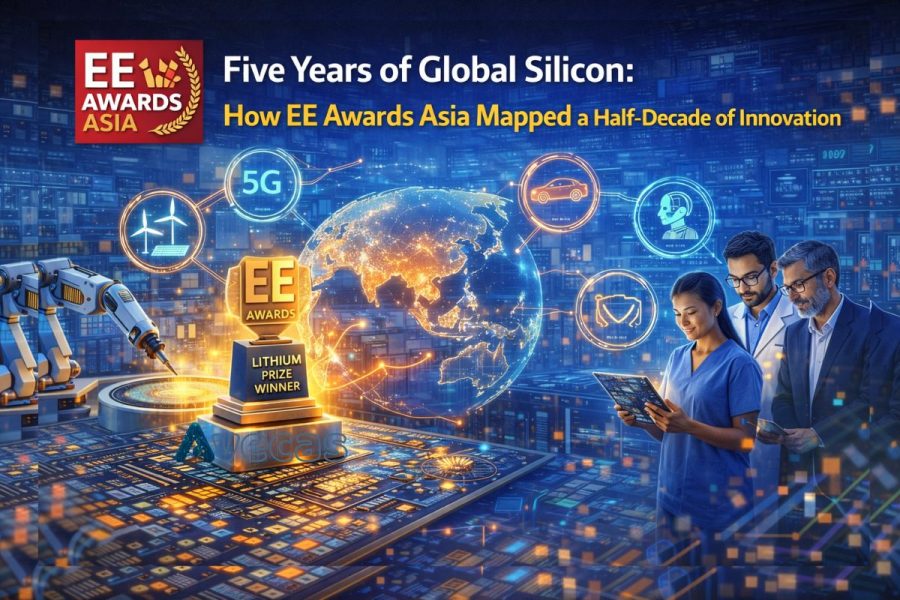
The electronics industry moves at a pace that often feels like a blur. However, once a year, the EE Awards Asia provides a rare moment of clarity, acting as a historical map for the semiconductor world.
As we hit the five-year milestone of these awards, a retrospective look reveals much more than just a list of winners. It traces the incredible arc of how the industry pivoted through a global pandemic, survived a supply chain crisis, and eventually surrendered to the transformative power of Generative AI.
2021-2022: From Survival to Sustainability
The inaugural EE Awards in 2021 were born in the middle of a global lockdown. Back then, the industry wasn’t obsessed with 2nm nodes or LLMs; it was obsessed with Resilience.
- The Connectivity Boom: Winning solutions focused on 5G, Wi-Fi 6, and ultra-low-power MCUs. The goal was simple: keep the world connected while everyone worked from home.
- The Green Shift: By 2022, the conversation shifted toward “Green Engineering.” Engineers began prioritizing energy efficiency not just for battery life, but as a core pillar of corporate responsibility.
2023-2024: The Rise of the Electric Machine
In 2023, the awards highlighted a massive intersection: the merging of the automotive and semiconductor worlds. This era was defined by the transition from hardware-centric cars to Software-Defined Vehicles (SDVs).
- Third-Gen Semiconductors: Power devices made from Silicon Carbide (SiC) and Gallium Nitride (GaN) took center stage. These “wide-bandgap” materials became the secret sauce for faster EV charging and longer driving ranges.
- Edge Intelligence: 2024 marked the year that AI moved out of the cloud and into our pockets. “Edge AI” became the dominant theme, requiring a rethink of how we design chips to handle massive data without burning through power.
Achieving success in these fast-moving cycles requires a disciplined approach to design. Most award-winning companies follow a rigorous path, often starting with the 6 essential steps in chip development to ensure their silicon is ready for the high-reliability demands of the automotive market.
2025-2026: The Age of System-Level Innovation
As we look at the most recent honorees, the focus has shifted from the “individual chip” to the “System-in-Package.”
- Advanced Packaging: Technologies like CoWoS (Chip on Wafer on Substrate) and Chiplets are now the primary frontier. Because we are hitting the physical limits of how small a transistor can be, we are now innovating by “stacking” different chips together.
- Generative AI Execution: The “execution phase” of AI is here. It’s no longer about showing off a cool demo; it’s about high-volume manufacturability and 24/7 reliability in the data center.
For many startups and mid-sized firms, navigating this complexity is the biggest hurdle. This is where specialized Production Test & Silicon Bring-Up support becomes invaluable, helping teams bridge the gap between a winning “Innovation Award” prototype and a mass-market success.
Celebrating the “Human” in the Hardware
Perhaps the most important takeaway from five years of EE Awards Asia is the recognition of the people behind the silicon. From legends like Dr. Chenming Hu (the father of FinFET) to the rising stars in the startup category, the awards remind us that electronics is fundamentally a human endeavor.
As the industry faces new challenges—like the rise of “Silicon Nationalism” and the push for 2nm dominance—the map provided by EE Awards Asia will continue to be our most reliable guide for what comes next.