

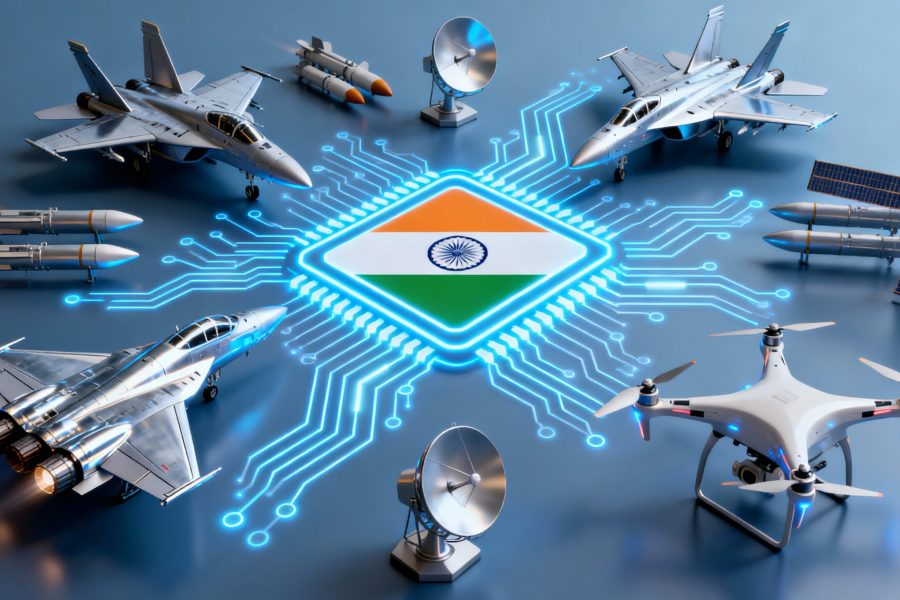
Modern defence capabilities today extend far beyond traditional arms and ammunition. The real battlefield is digital, intelligent, and interconnected. From drones and satellites to missile systems and radar networks, every sophisticated defence platform relies on the silent force inside it: semiconductor chips. These chips operate as the central brain, enabling computation, sensing, navigation, communication, and control.
For many years, India imported much of its semiconductor technology. While this supported hardware development, it created strategic vulnerabilities. In defence and aerospace, dependence on foreign chips can mean dependence on foreign decisions. This is why indigenous chip design is becoming a critical focus for India as it works towards technological sovereignty.
Chip Technology is at the Core of Defence Systems
Whether on land, in the air, at sea, or in space, defence equipment today is highly electronic. Chips control and optimise vital systems such as:
• Fighter aircraft avionics
• Missile guidance and propulsion
• Radar and surveillance systems
• Secure military communications
• Electronic warfare tools
• Navigation systems for satellites and spacecraft
• Unmanned and autonomous vehicles
Without high precision chips, defence systems lose efficiency, response capability, and reliability. The success of India’s defence and space missions increasingly depends on designing and owning these core electronics.
Why Indigenous Chip Design Matters
National Security and Independence
In times of conflict, access to imported microchips may be blocked, restricted, or manipulated. Foreign-made chips may also carry security risks such as hidden vulnerabilities or backdoor access. Indigenous design helps India control how chips are built, tested, secured, and deployed. This independence protects military assets from supply disruptions and cyber threats.
Tailored Performance for Harsh Environments
Commercial semiconductor components are designed for everyday electronics. Defence and aerospace systems, however, operate in extreme conditions including high heat, vibration, radiation, vacuum pressure, and long life cycles. Locally designed chips can be engineered and hardened to suit these demanding environments, ensuring performance, durability, and mission readiness.
Cybersecurity and Encryption Leadership
Secure command systems and encrypted communication lines are essential for military operations. Indigenous chip design allows India to embed advanced encryption, anti tamper mechanisms, and secure protocols at hardware level. This reduces vulnerability to espionage and strengthens digital defence resilience.
Defence Research Drives Chip Innovation
Globally, defence needs have often accelerated semiconductor development. India is on a similar trajectory. Research organisations such as DRDO, ISRO, HAL, and Bharat Electronics collaborate with academic institutions and deep technology startups to develop application specific processors, signal processing chips, satellite control systems, and high performance computing modules. Many of these innovations later benefit civilian industries including telecom, automotive, healthcare, and smart infrastructure.
ISRO as a Case Study for Indigenous Chips
India’s space missions offer a strong illustration of dependence on local chip technology. Satellites and spacecraft require radiation hardened chips capable of functioning reliably in space. ISRO has invested heavily in developing onboard computers, navigation modules, and payload management chips that are designed, tested, and validated within India. These components have contributed to the success of missions like Chandrayaan and the Mars Orbiter Mission, proving the value of indigenous semiconductor design.
Startups are Entering Defence Chip Design
A rising number of Indian startups are now working on semiconductor development for defence applications. Their innovations include processors for unmanned aerial vehicles, smart munitions, battlefield robots, aerospace sensors, secure communication modules, and simulation platforms. Support programs such as the iDEX initiative and semiconductor incubator schemes are funding research and enabling industry partnerships. This is expanding India’s talent pool and accelerating technology development.
Indigenous Chip Design and Atmanirbhar Bharat
India’s pursuit of self reliance aligns naturally with semiconductor independence. Locally designed chips reduce imports, increase export potential, enhance manufacturing capability, and create skilled employment. More importantly, they give India strategic confidence and protect national interests. Every defence system powered by an Indian designed chip takes the country one step closer to technological leadership.
Challenges to Address
Building defence grade semiconductor capability is complex. India continues to face challenges including limited fabrication infrastructure, high research costs, long development cycles, and a shortage of highly specialised engineers. However, consistent investment, international partnerships, academic collaboration, and government support are gradually bridging these gaps.
The modern defence landscape depends not only on physical strength but on digital superiority. Indigenous chip design is therefore no longer optional for India — it is a strategic necessity. By designing and controlling its own semiconductor technology, India ensures secure supply chains, eliminates external vulnerabilities, and tailors electronic systems to extreme battlefield and aerospace conditions.
A significant milestone in this journey was the development of Vikram-32, India’s first 32-bit microprocessor, created by the Defence Research and Development Organisation. Vikram-32 proved that India could design processors for mission-critical applications such as avionics, missile systems, and on-board computing. It laid the foundation for more advanced indigenous chip design programs, showing how defence-driven innovation can accelerate national semiconductor capability.
As India continues to invest in research, fabrication, and skill development, indigenous chips will increasingly power its satellites, missiles, surveillance systems, and autonomous platforms. The future of India’s defence and aerospace strength lies in mastering silicon technology. Every chip like Vikram-32 reinforces India’s ambition to achieve strategic independence and build a self-reliant, technologically strong nation.