

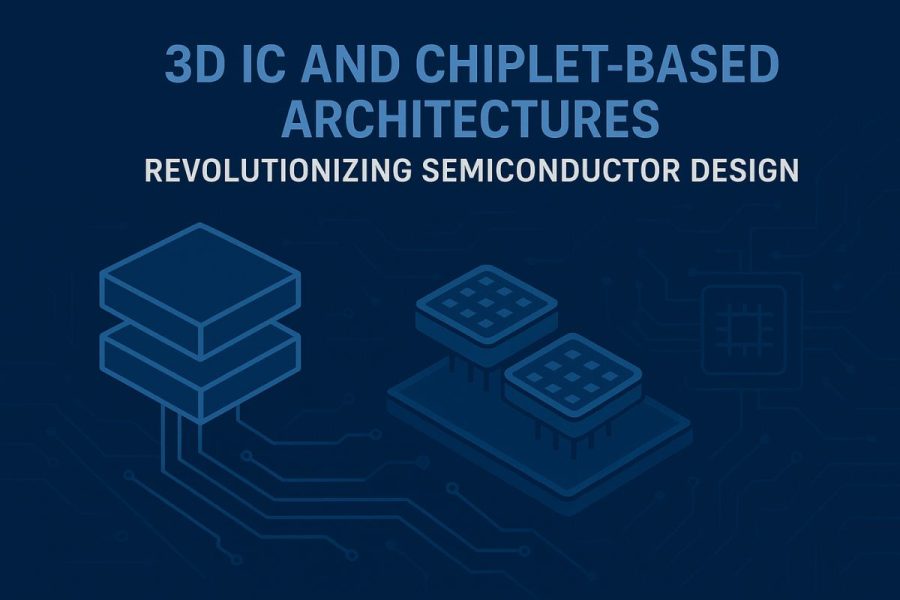
The semiconductor industry is embracing a transformative shift with 3D IC (Three-Dimensional Integrated Circuits) and chiplet-based architectures. These innovative approaches are redefining how chips are designed and manufactured, addressing the limitations of traditional 2D planar designs. From powering high-performance computing to enabling compact AI devices, 3D ICs and chiplets are paving the way for the next generation of electronics. This article explores their significance, benefits, challenges, and the future they promise.
What Are 3D ICs and Chiplet-Based Architectures?
3D ICs stack multiple layers of circuits vertically, connected through tiny vertical interconnects called Through-Silicon Vias (TSVs). This contrasts with the flat, 2D layouts of conventional chips, allowing for denser integration and shorter communication paths. On the other hand, chiplet-based architectures involve designing a chip as a collection of smaller, specialized dies (chiplets) that are packaged together. These chiplets can be mixed and matched, offering flexibility in design and production.
Together, these technologies are breaking the barriers of Moore’s Law, which predicted the doubling of transistors every two years on a shrinking node. As we move beyond 2nm processes, 3D ICs and chiplets provide alternative paths to enhance performance and efficiency.
Why 3D ICs and Chiplets Matter
The adoption of 3D ICs and chiplet architectures is driven by their ability to meet modern demands:
- Performance Leap: Vertical stacking in 3D ICs reduces signal delay, enabling faster data transfer. Chiplets allow optimized designs for specific tasks, boosting overall system speed.
- Power Efficiency: Shorter interconnects in 3D ICs lower power consumption, critical for battery-powered devices. Chiplets reduce waste by reusing proven designs, cutting energy use in manufacturing.
- Compact Design: Stacking layers or combining chiplets shrinks the chip footprint, ideal for space-constrained applications like wearables and smartphones.
- Cost Flexibility: Chiplets enable modular production, letting companies use older, cheaper nodes for some dies while upgrading others, balancing cost and performance.
Industry leaders like AMD, Intel, and TSMC are already leveraging these technologies, with AMD’s EPYC processors using chiplets to dominate data center performance.
Breakthroughs in 3D IC and Chiplet Design
Recent advancements are accelerating the adoption of these architectures:
- Advanced TSV Technology: Improved TSVs with lower resistance and higher density enhance 3D IC reliability, supporting stacks of 10+ layers.
- Heterogeneous Integration: Chiplets allow combining different process nodes (e.g., 7nm and 3nm) or technologies (logic and memory) in one package, optimizing for diverse workloads.
- Thermal Management: Innovations like microfluidic cooling and heat spreaders address the thermal challenges of 3D stacking, ensuring stable operation.
- High-Bandwidth Memory (HBM): 3D ICs integrate HBM vertically, delivering massive bandwidth for AI and graphics applications, as seen in NVIDIA’s H100 GPU.
TSMC’s 3DFabric and Intel’s Foveros are leading examples, showcasing how these techniques are scaling production.
Real-World Applications
The impact of 3D ICs and chiplets spans multiple industries:
- High-Performance Computing: Data centers use chiplet-based CPUs like AMD’s Zen architecture for superior multi-core performance.
- Artificial Intelligence: AI accelerators benefit from 3D ICs’ dense memory integration, speeding up neural network training.
- Automotive: Self-driving cars rely on chiplets for modular, reliable systems that process sensor data in real-time.
- Consumer Electronics: Smartphones and gaming consoles leverage 3D ICs for compact, powerful chips that enhance user experiences.
Challenges in Implementation
Despite their potential, 3D ICs and chiplets face hurdles:
- Thermal Issues: Stacking layers increases heat density, requiring advanced cooling solutions that add complexity and cost.
- Manufacturing Complexity: Aligning and connecting multiple layers or chiplets demands precision, raising yield concerns.
- Testing Difficulties: Verifying stacked or multi-die designs is challenging, as traditional methods struggle with 3D structures.
- Supply Chain Dependence: The global shortage of advanced packaging expertise and equipment limits scalability.
Researchers are tackling these with AI-driven design tools and improved packaging standards, but progress requires time and investment.
The Future of 3D ICs and Chiplets
Looking ahead, the evolution of these technologies promises exciting developments:
- Sub-2nm Nodes: 3D ICs will complement advanced nodes, allowing further miniaturization without relying solely on shrinking transistors.
- Modular Ecosystems: Chiplet marketplaces could emerge, where companies share and trade specialized dies, fostering innovation.
- Quantum Integration: Future 3D ICs might incorporate quantum components, blending classical and quantum computing.
- Sustainability: Eco-friendly materials and reusable chiplet designs could reduce the environmental footprint of chip manufacturing.
By 2030, analysts predict 3D ICs could account for 20% of high-performance chip production, with chiplets driving modular designs across the industry.
How to Get Involved
Interested in exploring this field? Here’s a practical guide:
- Learn the Basics: Take courses on 3D IC design and packaging via platforms like Coursera or edX.
- Master Tools: Use EDA software like Cadence Innovus or Synopsys IC Compiler to simulate 3D and chiplet designs.
- Hands-On Practice: Experiment with open-source projects or university labs focusing on TSV integration.
- Join Communities: Connect with peers at SEMICON events or IEEE groups dedicated to 3D ICs.
- Stay Updated: Follow updates from TSMC, Intel, and AMD via their technical blogs or whitepapers.
Conclusion
3D IC and chiplet-based architectures are revolutionizing semiconductor design, offering a path to overcome the limitations of traditional 2D chips. As of August 24, 2025, these technologies are powering high-performance computing, AI, and automotive innovations, with a bright future ahead. Despite challenges like thermal management and manufacturing complexity, ongoing advancements promise a new era of efficiency and scalability. Whether you’re an engineer, student, or tech enthusiast, diving into 3D ICs and chiplets opens doors to shaping the electronics of tomorrow. Join the revolution and explore this exciting frontier.