

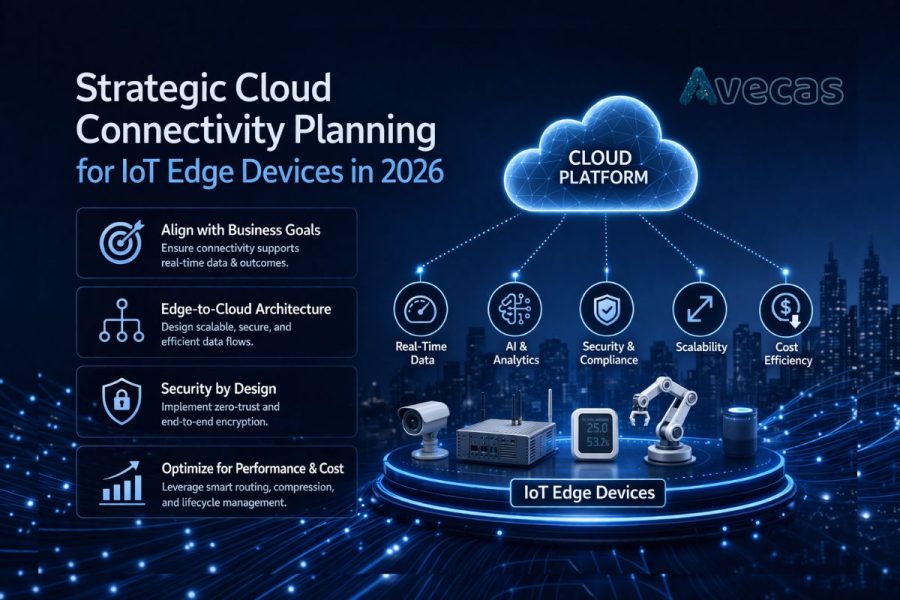
In the semiconductor landscape of 2026, the concept of a “simple” sensor is a relic of the past. We have transitioned into an era where IoT edge devices are expected to perform complex local analytics, run lightweight machine learning models, and maintain seamless communication with global cloud infrastructures.
We see cloud connectivity not as a final step, but as a foundational architectural decision. Choosing the wrong connectivity path can lead to a device that drains its battery in days, suffers from massive latency, or becomes a wide open door for security threats. Effective planning requires a deep dive into the trade-offs between power, range, and data throughput.
1. Protocol Selection: Matching Range to Use Case
The first consideration in any connectivity plan is the wireless protocol. In 2026, the market is no longer dominated by just Wi-Fi or Bluetooth. We must choose based on the physical environment and the frequency of data transmission.
- Low Power Wide Area Networks (LPWAN): For devices like smart agricultural sensors or utility meters that sit miles away from a gateway, protocols like LoRaWAN or NB-IoT are essential. They offer extreme range and years of battery life by sending small bursts of data.
- Cellular IoT (LTE-M and 5G RedCap): For mobile edge devices, such as autonomous delivery robots, 5G Reduced Capability (RedCap) provides high reliability and lower latency without the massive power drain of full scale 5G.
- Matter and Thread: In the smart home and building automation sectors, the adoption of the Matter standard has simplified connectivity, allowing edge devices from different manufacturers to communicate locally before hitting the cloud.
2. Bandwidth Management and Data Throttling
A common mistake in IoT planning is assuming the cloud needs to see every bit of raw data. In 2026, data transmission is the most “expensive” operation in terms of power consumption.
Strategic connectivity planning involves Edge Intelligence. Instead of streaming raw vibration data from a factory motor to the cloud, the semiconductor at the edge should process that data locally. The device should only connect to the cloud to report an anomaly or a summarized daily health report. This “exception-based reporting” significantly reduces cloud storage costs and extends the lifespan of the edge device’s battery.
3. Security: The Silicon to Cloud Trust Chain
As billions of new edge nodes come online in 2026, they represent a massive attack surface. Connectivity planning must include a robust security framework that starts in the silicon itself.
- Hardware Root of Trust (RoT): Every edge device should have a unique, unalterable identity burned into the silicon. This allows the cloud to verify that the device is legitimate before accepting any data.
- Mutual Authentication: The device must verify the cloud, and the cloud must verify the device. This “handshake” ensures that data isn’t being intercepted by a “man-in-the-middle” attack.
- Over the Air (OTA) Updates: A connected device is only as secure as its last update. Planning must include a secure, low-bandwidth path for pushing firmware patches to the edge without interrupting the device’s core mission.
4. Latency and Determinism in Physical AI
For 2026 applications like Physical AI and humanoid robotics, latency is a safety critical metric. If an edge device relies on the cloud for real-time decision making, a momentary drop in connectivity could be catastrophic.
Connectivity planning must define what is “mission critical” versus what is “analytical.” Critical control loops should always be handled locally at the edge. The cloud connection should be reserved for high level coordination, long term data logging, and model retraining. This hybrid approach ensures that the device remains functional and safe even when the cloud is temporarily unreachable.
5. Managing Thermal and Power Budgets
Every time a radio turns on to talk to the cloud, it generates heat and consumes current. In ultra-compact IoT designs, managing this thermal envelope is a major VLSI challenge. At Avecas, we focus on optimizing the Power Management Integrated Circuits (PMICs) that feed these radios.
Advanced connectivity planning includes “sleep scheduling,” where the radio remains in a deep sleep state for 99% of the time, waking up only for a few milliseconds to sync with the cloud. This requires precision timing and fast wake-up circuits to ensure that no data is lost during the transition.
Conclusion: The Avecas Approach to Connected Silicon
Cloud connectivity planning is the art of balancing conflicting requirements. You want infinite range but zero power consumption. You want massive bandwidth but total security. While no single protocol solves everything, a well-planned architecture makes the best use of the available silicon.
For the next generation of engineers, the challenge is to think beyond the device. You are building a nervous system for the planet. By considering these strategic factors early in the design phase, we can ensure that the IoT edge of 2026 is not just connected, but is intelligent, secure, and sustainable. At Avecas, we are committed to providing the VLSI expertise and system-level insights needed to turn these complex connectivity plans into high-performance reality.