

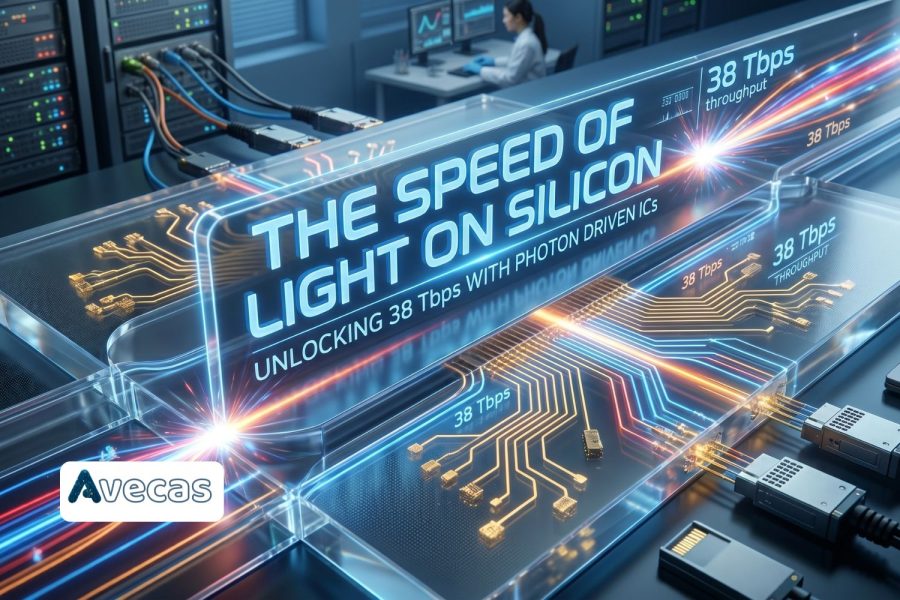
For decades, we have relied on copper traces to move data between the cores, memory, and accelerators that power our world. But as we push into the era of massive AI clusters and hyperscale data centers in 2026, we are hitting a physical wall. Copper interconnects are struggling with three major enemies: heat, power consumption, and signal degradation.
When we try to push more data through metal wires, the resistance and capacitance create a bottleneck that limits speed and generates massive amounts of thermal energy. To solve this, the semiconductor industry is turning to a medium that has no such limits: light. Photon driven ICs are no longer a laboratory curiosity. They are the essential architecture for achieving 38 Tbps on chip communication.
Why Silicon Photonics is the Answer
Silicon photonics is the marriage of two worlds: the high speed communication of fiber optics and the low cost scalability of CMOS manufacturing. By integrating optical components like lasers, modulators, and photodetectors directly onto a silicon substrate, we can move data using photons instead of electrons.
The advantages are transformative. Photons do not generate heat through resistance, and they do not suffer from the same electromagnetic interference that plagues high speed copper traces. Most importantly, light allows for much higher bandwidth density. We can pack more data into the same physical space by using different wavelengths of light, a technique known as Wavelength Division Multiplexing.
Breaking the 38 Tbps Barrier
Achieving 38 Tbps on a single chip is a staggering milestone. To put that in perspective, that is fast enough to download thousands of high definition movies in a single second. In 2026, this throughput is the lifeblood of Large Language Models and real time digital twins.
The 38 Tbps throughput is achieved by combining multiple optical channels into a single silicon waveguide. Each channel operates at a different color or wavelength. By using advanced modulation techniques like PAM4 or coherent signaling, each wavelength can carry massive amounts of data. When you scale this across hundreds of waveguides on a single die, you reach the 38 Tbps threshold. This allows for a seamless flow of information between the GPU cores and high bandwidth memory, effectively eliminating the latency that once slowed down AI training.
Co-Packaged Optics: The Integration Frontier
The most significant shift we are seeing in the industry is the move toward Co-Packaged Optics. Traditionally, optical transceivers were separate modules placed on the edge of the PCB. This created a long electrical path between the processor and the light source, which wasted power.
In a 38 Tbps photon driven IC, the optics are moved inside the processor package. This proximity reduces the electrical reach to just a few millimeters, drastically lowering the energy required to move every bit of data. This “Co-Packaging” is what makes 38 Tbps commercially viable. It ensures that the power saved by using light is not lost in the electrical interface.
Industry Impact: From AI to 6G
The impact of photon driven ICs ripples across the entire tech ecosystem.
- AI Clusters: In the race to build the next generation of artificial intelligence, communication between chips is just as important as the processing power within them. 38 Tbps interconnects allow thousands of chips to act as a single, massive brain.
- Sustainable Data Centers: By reducing the heat generated by interconnects, silicon photonics helps data centers lower their cooling costs and carbon footprints.
- 6G Infrastructure: As we look toward 6G, the need for ultra low latency and high throughput at the edge will make photon driven ICs a standard requirement for telecommunications hardware.
Learning the New Silicon Language
For engineers and students, the rise of photon driven ICs means we need to expand our toolsets. We can no longer think only in terms of voltages and currents. We must now understand refractive indices, waveguide geometry, and optical phase shifting. The design tools of 2026 are evolving to handle this “Hybrid” design flow, where electrical and optical simulations happen in the same environment.
Learning how to manage the “Thermal Tuning” of these optical circuits is becoming a core skill. Because silicon waveguides are sensitive to temperature, designers use tiny on-chip heaters and AI-driven control loops to keep the light perfectly aligned.
Conclusion: A Future Guided by Light
Photon driven ICs represent the most significant change in chip architecture since the invention of the transistor. By harnessing silicon photonics to reach 38 Tbps, the industry is not just making chips faster: it is reimagining what a chip can be.
As we look at the hardware hitting the market this year, it is clear that light has become the new copper. The interconnect bottleneck is being shattered, and the resulting explosion in bandwidth will fuel the next decade of digital innovation. The future of silicon is no longer just electrical: it is optical, and it is moving at the speed of light.