

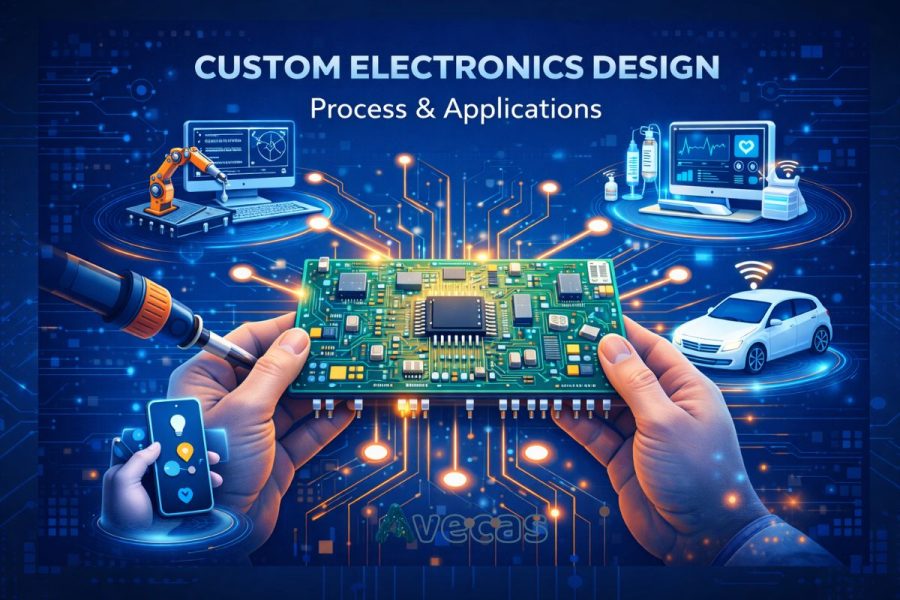
Introduction
In today’s technology-driven world, off-the-shelf solutions often fall short when innovation, efficiency, or differentiation is key. That’s where custom electronics design comes in, creating tailor-made electronic systems that precisely match product specifications and business goals.
Whether you’re building smart devices, industrial controllers, or IoT hardware, custom electronics designs unlock better performance, lower long-term costs, and unique functionality that set products apart in competitive markets.
In this article, we’ll explore what custom electronics design is, why it matters, how the process works, and where it’s used most effectively.
What Is Custom Electronics Design?
Custom electronics design refers to the process of engineering a unique electronic system, including hardware and embedded software, specifically built to meet a product’s exact requirements. Unlike generic off-the-shelf modules, custom electronics are optimized for:
- Targeted performance
- Specific feature sets
- Efficient power usage
- Compact form factors
- Integration with mechanical systems
These designs are widely used in industries where standard components can’t deliver the right mix of capability and cost-effectiveness.
Key Benefits of Custom Electronics
1. Tailored Performance
Off-the-shelf components are built to address broad generic use cases. Custom electronics deliver precisely what a project needs no more, no less resulting in better performance for defined tasks.
2. Competitive Differentiation
In products like wearables, smart home devices, or industrial tools, unique hardware enables features your competitors can’t replicate easily.
3. Cost Optimization
By eliminating unnecessary features and focusing only on required functions, custom designs can reduce production and lifecycle costs.
4. Integration and Size Efficiency
Custom PCBs and modules can be developed to fit specific enclosures and mechanical constraints, improving overall product compactness.
5. Improved Reliability
Purpose-built electronics are engineered for the specific operating environment of the product, boosting durability and long-term reliability.
Typical Custom Electronics Design Workflow
Designing custom electronics follows a structured process to ensure quality, performance, and manufacturability:
1. Requirement Gathering
This first step involves understanding functional needs, environment constraints, regulatory requirements, and business goals. Clear early requirements reduce redesigns later in the process.
2. System Architecture & Component Selection
Engineers plan the system layout, choose the right microcontroller or processor, sensors, communication modules, and power components based on performance, cost, and power budget.
3. Schematic Design
Using industry-standard design tools, a detailed electrical schematic is created showing component connections and signal flows.
4. PCB Layout & Routing
The schematic is translated into a physical Printed Circuit Board (PCB). Here, spacing, trace widths, grounding, and signal integrity are carefully managed.
5. Prototype Development
A prototype board is fabricated and assembled to test the initial design in real hardware. Engineers validate functions, timing, power, and signal behavior.
6. Firmware and Embedded Software Development
Embedded code is written and tested to control hardware components, handle communication, and execute application logic as required.
7. Testing & Validation
Rigorous testing — functional, environmental, and compliance — ensures the design meets specifications and safety requirements.
8. Production & Scaling
Once validated, the design moves into manufacturing, quality assurance, and eventual product rollout.
Core Components in Custom Electronics
A custom electronics design may include:
- Microcontrollers / processors — central computation units
- Sensors — data acquisition from the environment
- Power modules — efficient energy management
- Communication modules — Wi-Fi, Bluetooth, cellular, or wired interfaces
- PCBs — structured platforms that support and connect components
Good component selection and integration is key to achieving performance and cost targets.
Popular Applications of Custom Electronics
Custom electronics design has broad utility across industries:
Industrial Automation
Tailor-made controllers and monitoring units enhance efficiency, safety, and predictive maintenance in manufacturing environments.
Medical Devices
Medical equipment requires precise, reliable hardware designed for safety and compliance. Custom electronics help meet these stringent standards.
Smart Consumer Products
Wearables, smart home devices, and lifestyle gadgets often rely on purpose-built electronics to deliver unique capabilities.
IoT Hardware
From smart sensors to connected gateways, custom electronics are central to high-performance IoT systems.
Automotive & Transportation
Embedded hardware in automotive systems manages safety, efficiency, and connectivity in modern vehicles.
Factors to Consider in Custom Electronics Projects
When planning a custom electronics project, consider the following:
- Regulatory compliance (EMC, safety standards)
- Power efficiency and thermal design
- Maintainability and future upgrades
- Manufacturing scalability
- Cost vs performance targets
These decisions early in the design phase can dramatically impact long-term success and cost.
Conclusion
Custom electronics design is a strategic enabler for innovation. By crafting purpose-built systems with optimized hardware and software working in sync, companies unlock unique product advantages, lower lifecycle costs, and deliver better user experiences.
Whether you’re launching a new product or improving an existing one, smart custom design gives you control over performance, quality, and differentiation.