

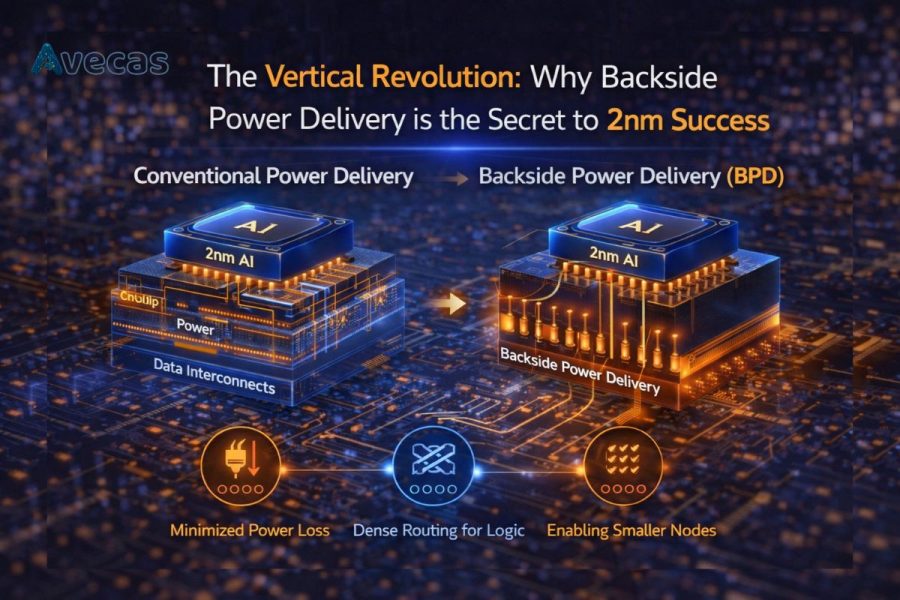
In past years of documenting the evolution of silicon, we have seen many milestones, but few are as physically transformative as the shift we are witnessing in 2026. For over half a century, the architectural blueprint of an integrated circuit followed a singular, logical path. We built the transistors on the silicon substrate, and then we layered all the wiring on top of them. This top down approach, known as frontside power delivery, served us well through the micro and nano eras.
However, as we push into the 2nm and 1.6nm regimes, this classic design has hit a physical wall. The top layers of a modern high performance chip are now a chaotic traffic jam of microscopic copper. Power delivery wires must compete for space with signal wires that carry data. To reach the transistors at the very bottom, electricity has to navigate a vertical labyrinth of fifteen or more metal layers. By the time the current reaches its destination, it has lost significant energy, a phenomenon known as the voltage drop or IR drop crisis.
Solving the Voltage Drop Crisis
The IR drop is not just a technical nuisance, it is a barrier to performance. As wires get thinner at the 2nm node, their resistance increases. This means more heat and less stable voltage for the logic gates. If the voltage drops too low, the transistors cannot switch at their maximum frequency, effectively neutralizing the benefits of moving to a smaller process node.
Backside Power Delivery (BPD) is the industry’s radical answer to this dilemma. The concept is simple yet brilliant: move the entire power delivery network to the other side of the wafer. By relocating the thick, low resistance power rails to the rear of the silicon, we deliver energy directly to the transistors from below. This decouples the power and signal networks for the first time in history, clearing the “congestion” on the frontside and allowing for a much cleaner, more efficient architecture.
The Major Players: PowerVia and Super Power Rail
As we move through 2026, the two titans of the foundry world have introduced their own distinct flavors of this technology. Intel was the first to demonstrate this at scale with its PowerVia technology, which is a cornerstone of the Intel 18A node. By using specialized “Nano Through Silicon Vias” (nTSVs), Intel has shown that they can improve cell utilization to over 90% while significantly reducing the voltage droop that plagued earlier designs.
On the other side, TSMC has unveiled its Super Power Rail for the A16 node. This implementation is even more ambitious, connecting the backside power network directly to the source and drain of the transistors. This direct connection minimizes resistance even further, promising a double digit increase in performance for the massive AI clusters that define our current technological era.
The Manufacturing Magic: Thinning and Bonding
Implementing BPD is one of the most difficult manufacturing feats in the history of VLSI. It requires a process known as wafer bonding and extreme thinning.
First, the transistors and signal wires are built on a standard wafer. Then, that wafer is flipped over and bonded to a “carrier” wafer. The original silicon substrate is then ground down until it is only a few micrometers thick, almost as thin as a soap bubble. Only then can the foundries etch the nano-vias and build the massive power distribution network on the new “backside.” The precision required to align these backside wires with the transistors on the other side is measured in mere nanometers.
Why 2026 AI Clusters Demand BPD
The urgency behind this transition is driven almost entirely by the explosive growth of AI. In 2026, we are no longer building chips that draw 100 watts; we are building AI accelerators that demand 1000 watts or more. Delivering that much current through a traditional frontside network would result in catastrophic heat and efficiency loss.
BPD allows these mega chips to run cooler and faster. By separating the “noisy” power lines from the sensitive data signals, we also reduce electromagnetic interference. This leads to better signal integrity, which is essential for the ultra high speed interconnects required to link thousands of GPUs together into a single cohesive AI cluster.
Conclusion: Flipping the Future of Silicon
Backside Power Delivery is the vertical revolution that the semiconductor industry needed to keep Moore’s Law alive. It is the secret ingredient that makes 2nm performance a reality rather than just a theoretical target. By looking at the chip from a new perspective, quite literally, we have solved the voltage drop crisis and paved the way for the next decade of computational growth.
For the VLSI community, BPD represents a shift in how we think about design. We are no longer limited to a two dimensional layout on the surface of the silicon. We are now building truly three dimensional systems where every micrometer of the wafer, front and back, is optimized for peak performance. In the high stakes world of 2026, the future of silicon is no longer just about getting smaller; it is about getting smarter with how we power our world.