

Introduction
In today’s connected world, embedded systems power countless everyday devices — from smartphones and home appliances to industrial machines and smart vehicles. At its core, embedded systems design is the art and science of creating purpose-built computing systems that perform dedicated tasks efficiently within larger mechanical or electrical systems.
This guide explains what embedded systems are, how designers build them, the essential components involved, and where these systems are used across industries.
What Is Embedded Systems Design?
Embedded systems design refers to the process of developing a compact, efficient computing unit that’s integrated into a larger device to solve a specific problem or perform a defined function. Unlike general-purpose computers that run multiple applications, embedded systems are mission–specific, optimized for reliability, speed, and power efficiency.
These systems combine hardware (like microcontrollers or processors) with tailored software, often running on a real-time operating system (RTOS), to monitor inputs, process data, and control outputs with minimal human intervention.
Key Attributes of Embedded Systems
Embedded systems have several distinct qualities:
- Task-specific functionality: Designed to accomplish a particular job with precision.
- Real-time operation: Many systems must respond instantly to external events.
- Low power consumption: Energy efficiency is crucial, especially for battery-operated products.
- Compact footprint: Usually small and lightweight to fit within device constraints.
- High reliability: Must operate consistently in diverse environments.
Core Components of Embedded Systems
Designing an embedded system involves integrating several key parts:
1. Processor (MCU or MPU)
The central component that executes instructions. Microcontrollers are highly integrated chips combining a processor core with memory and peripherals, while microprocessors offer more complex processing power.
2. Memory Units
Embedded systems include:
- Program memory: Stores the system’s software (e.g., Flash, ROM).
- Data memory: Temporary storage for runtime tasks (e.g., RAM).
3. Input/Output Interfaces
These connect sensors, switches, and actuators to the processor, enabling the system to interact with the environment. Common buses include UART, SPI, and I2C.
4. Software & RTOS
Embedded software, often written in languages like C/C++, defines device logic. Real-time operating systems help schedule tasks and manage time-critical processes.
5. Power Management
Ensures stable energy supply whether powered by battery or mains. Since many embedded devices operate with limited power, efficient power design is critical.
The Embedded Systems Design Process
Building an embedded system typically follows a structured workflow:
1. Requirement Analysis
Define exactly what the system must do, including performance, power, and cost constraints.
2. System Architecture
Select hardware and software modules, define how they’ll work together, and choose the appropriate processor type.
3. Hardware Development
Design and prototype printed circuit boards (PCBs), select components, and optimize power supply.
4. Firmware & Software Coding
Develop embedded code that manages hardware operations reliably under real-time constraints.
5. Testing and Validation
Verify functionality under real-world conditions, ensuring timing, reliability, and performance goals are met.
6. Deployment and Maintenance
Once validated, the system is manufactured and deployed. Firmware updates and ongoing support keep it optimized over time.
Types of Embedded Systems
Embedded systems can differ based on complexity and connectivity:
- Standalone systems: Operate independently without network dependency.
- Real-time embedded systems: Provide guaranteed responses within specified time limits.
- Networked systems: Communicate with other devices over networks, essential for IoT.
Real-World Applications
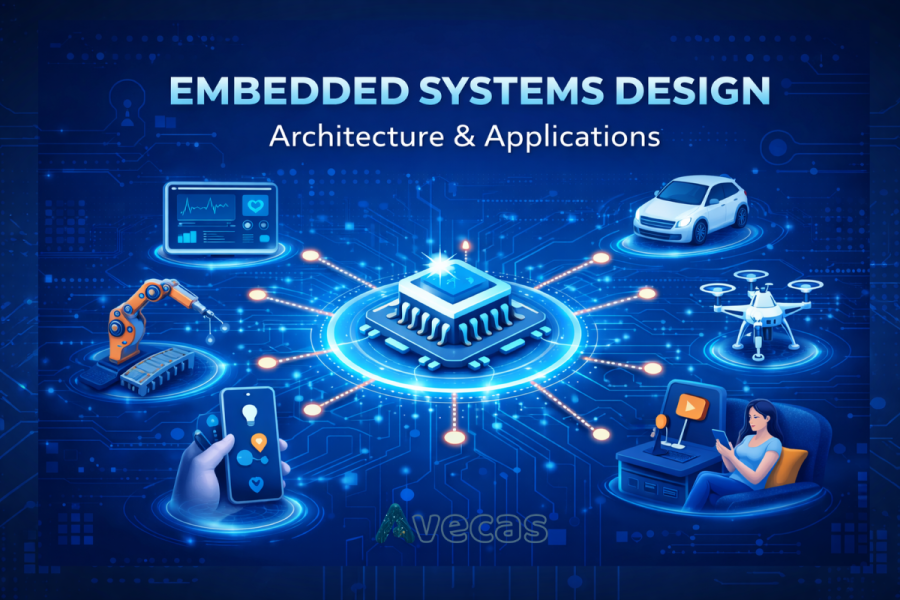
Embedded systems are everywhere — often unseen, but vital:
Automotive: Engine control units, infotainment systems, and safety controllers.
Healthcare: Portable medical monitors and diagnostic machines.
Consumer Electronics: Smart appliances, wearables, game consoles.
Industrial Automation: Robotics, process control, and predictive maintenance systems.
Aerospace & Defense: Navigation systems and mission-critical control units.
Conclusion
Embedded systems design is the backbone of intelligent electronics today. By combining thoughtfully chosen hardware and finely tuned software, engineers create devices that are efficient, reliable, and purpose-driven. Whether supporting smart consumer gadgets or powering industrial automation, the embedded design discipline continues to shape the future of connected technology.