

Introduction
Backend semiconductor engineering has always been one of the most demanding phases of chip development. As designs move to advanced technology nodes and system complexity grows, backend teams face increasing pressure to deliver high performance, low power, and manufacturable silicon within shorter timelines.
With artificial intelligence becoming deeply embedded into electronic design automation and manufacturing workflows, the backend landscape is undergoing a major transformation. The future of backend semiconductor engineering is no longer just about manual optimization, it is about intelligent collaboration between engineers and AI systems.
This article explores how backend engineering is evolving in the AI era, what changes are coming, and how engineers and organizations can prepare for the future.
What Backend Semiconductor Engineering Involves
Backend semiconductor engineering focuses on converting a logical chip design into physical silicon ready for manufacturing. Core responsibilities include:
- Floorplanning and placement
- Clock tree synthesis and routing
- Timing closure and signoff
- Power integrity and thermal analysis
- Reliability checks and manufacturability
- Engineering change orders and validation
These steps are highly iterative and data intensive, making backend workflows ideal candidates for AI driven enhancement.
Why AI Is Transforming Backend Engineering
Modern backend design generates massive datasets related to timing, congestion, power, and variability. Managing this complexity manually is becoming increasingly difficult.
AI is being introduced to backend engineering to address:
- Growing design complexity at advanced nodes
- Long iteration cycles during timing and signoff
- Rising cost of late stage design errors
- Need for faster time to market
By analyzing patterns across large datasets, AI enables smarter decisions and faster optimization.
AI Driven Changes in Backend Design Workflows
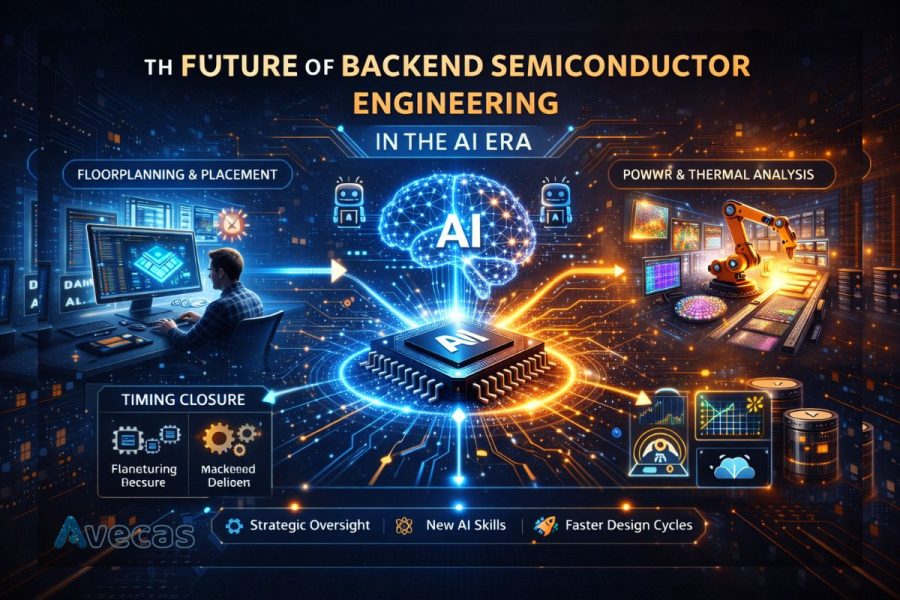
Intelligent Floorplanning and Placement
AI systems can evaluate thousands of placement strategies and identify optimal layouts that balance timing, power, and congestion more efficiently than manual approaches.
Autonomous Timing Closure
Instead of repeated manual tuning, AI driven tools can predict timing violations and propose fixes early, reducing the number of late stage iterations.
Power and Thermal Optimization
AI models analyze power distribution and thermal behavior, helping engineers identify hotspots and optimize designs for efficiency and reliability.
Automated ECO Handling
AI accelerates engineering change order implementation by suggesting minimal impact fixes and validating results automatically.
How the Role of Backend Engineers Is Evolving
AI is changing how backend engineers work, not eliminating their role.
From Manual Optimization to Strategic Oversight
Engineers are shifting from hands-on parameter tuning to guiding AI driven workflows and validating outcomes.
Greater Focus on Constraints and Architecture
Defining accurate constraints, understanding system architecture, and making tradeoff decisions are becoming central responsibilities.
Collaboration With Intelligent Tools
Backend engineers will increasingly work alongside AI agents that act as assistants, accelerating tasks and providing insights.
New Skills Required in the AI Era
To thrive in the future, backend engineers will need to expand their skill sets.
- Understanding AI assisted EDA tools
- Interpreting AI generated recommendations
- Managing design data and workflows
- Strengthening fundamentals in timing, power, and reliability
- Developing problem solving and decision making skills
Engineers who adapt to AI driven environments will gain a competitive edge.
Impact on Semiconductor Organizations
For semiconductor companies, AI driven backend engineering enables:
- Faster design cycles and reduced turnaround time
- Improved first time right silicon success
- Lower development and manufacturing costs
- Better scalability across multiple projects and nodes
Organizations that adopt AI early will be better positioned to handle future design challenges.
Challenges and Responsible Adoption
While AI brings clear benefits, responsible adoption is critical.
- Ensuring trust and validation of AI outputs
- Avoiding over dependence on automation
- Integrating AI tools with existing design flows
- Maintaining accountability for final signoff
Balanced collaboration between engineers and AI systems is key to long term success.
What the Future Looks Like
The future of backend semiconductor engineering will be defined by intelligent automation combined with human expertise. AI will handle repetitive, data heavy tasks, while engineers focus on architecture, strategy, and innovation.
As chip complexity continues to grow, backend engineers empowered by AI will be able to deliver better designs faster and more reliably than ever before.
Conclusion
The AI era is redefining backend semiconductor engineering. Rather than replacing engineers, AI is transforming how work is done, enabling smarter optimization, faster convergence, and improved design quality.
Backend engineers who embrace AI driven workflows will remain central to semiconductor innovation, shaping the next generation of high performance, energy efficient, and reliable chips. The future belongs to teams that combine human expertise with intelligent automation.