

In my fifteen years of covering the semiconductor industry, I have watched us squeeze every possible drop of performance out of silicon. We have moved from planar transistors to FinFETs and now to Gate All Around architectures. Yet, a silent bottleneck has been lurking beneath the die. The substrate, the very foundation upon which our chips sit, has remained largely dependent on organic laminates for decades.
As we hit the mid point of 2026, the massive requirements of AI clusters have pushed these organic materials to their physical breaking point. The industry is no longer just talking about alternatives, it is actively shifting toward Glass Core Substrates (GCS). This transition represents one of the most significant pivots in the history of advanced packaging, and it is the only way to support the high speed interconnects that modern intelligence demands.
The Problem with the Legacy Foundation
Organic substrates are essentially a mix of epoxy resin and glass fibers. While they are cost effective and easy to manufacture, they possess inherent flaws that become catastrophic at 2026 scales.
First, there is the issue of “warpage.” As AI chips grow larger and integrate more chiplets, the thermal expansion of organic materials does not match the silicon they carry. This mismatch causes the substrate to bend and warp under high heat, leading to cracked connections or “micro bumps” that fail to make contact.
Second, organic materials have a rough surface at the microscopic level. In the world of high frequency signals, this roughness causes signal degradation, known as insertion loss. When you are trying to push data at terabit speeds between an AI GPU and its memory, you cannot afford to lose signal strength to a bumpy plastic surface.
Why Glass is the Superior Architect
Glass is not just for windows anymore. In the context of a semiconductor package, glass offers a suite of physical properties that organic laminates simply cannot match.
1. Unmatched Dimensional Stability
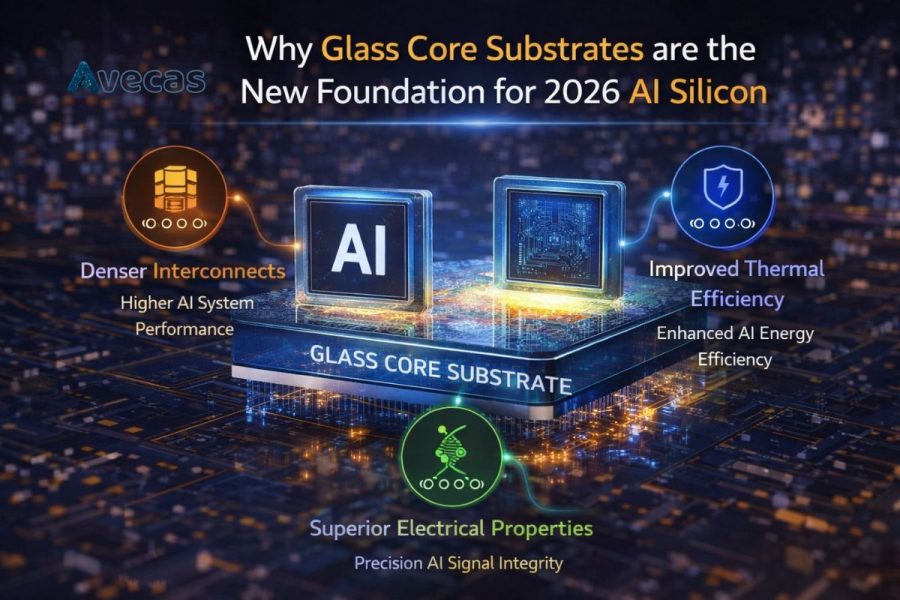
Glass is incredibly rigid and has a coefficient of thermal expansion that can be engineered to perfectly match silicon. This means that as a 1000 watt AI processor heats up, the glass substrate expands at the exact same rate as the chip. This stability allows us to build much larger packages, spanning 100mm by 100mm or more, without the fear of mechanical failure.
2. Superior Flatness for High Density Routing
The surface of glass is almost perfectly flat. This allows lithography tools to pattern much finer copper traces than they ever could on organic resin. In 2026, we are seeing interconnect densities that are five to ten times higher than previous generations. This flatness also enables the use of Through Glass Vias (TGVs), which are tighter and more precise than the holes drilled in organic boards.
3. Better Electrical Performance
Glass is an excellent insulator with low dielectric loss. It allows high speed signals to travel longer distances with less power. For the massive interconnects required in AI clusters, this means we can move more data while generating less waste heat, a critical win for data center efficiency.
The 2026 AI Cluster Requirement
Why is this shift happening exactly now? The answer lies in the architecture of 2026 AI clusters. We are no longer building “chips,” we are building “systems in a package.” A single AI accelerator today might contain a dozen compute chiplets, several stacks of High Bandwidth Memory, and high speed I/O dies all sitting on one substrate.
The interconnects between these pieces must be ultra fast and ultra reliable. If the substrate warps even slightly, the entire $40,000 module becomes a paperweight. Glass provides the structural integrity and signal clarity required to make these massive heterogeneous systems a reality. Companies like Intel, Samsung, and various specialized substrate providers have spent years perfecting the handling of ultra thin glass sheets to meet this specific moment in history.
Overcoming the Brittle Factor
A common question I get from veteran engineers is about the fragility of glass. After all, glass breaks. However, the semiconductor industry is not using the glass from a drinking cup. These are specialized, chemically strengthened glass cores that are remarkably resilient.
The manufacturing challenge in 2026 has been moving from small wafers to “Panel Level Packaging.” By processing glass on large rectangular panels, foundries can achieve massive economies of scale. This transition has required entirely new handling equipment and cleanroom protocols to ensure that the glass does not chip or crack during the complex build up process.
Conclusion: A Clear Path Forward
The move to Glass Core Substrates is a clear signal that the semiconductor industry has entered the “More than Moore” era. We have realized that the package is just as important as the silicon itself. By abandoning the limitations of organic laminates, we are clearing the path for the next decade of AI growth.
For the VLSI community, GCS is a reminder that innovation often happens in the most overlooked places. In 2026, the foundation of the world’s most powerful AI is no longer plastic, it is glass. It is a smoother, flatter, and more stable foundation that will carry our digital ambitions into the next generation of computing.