

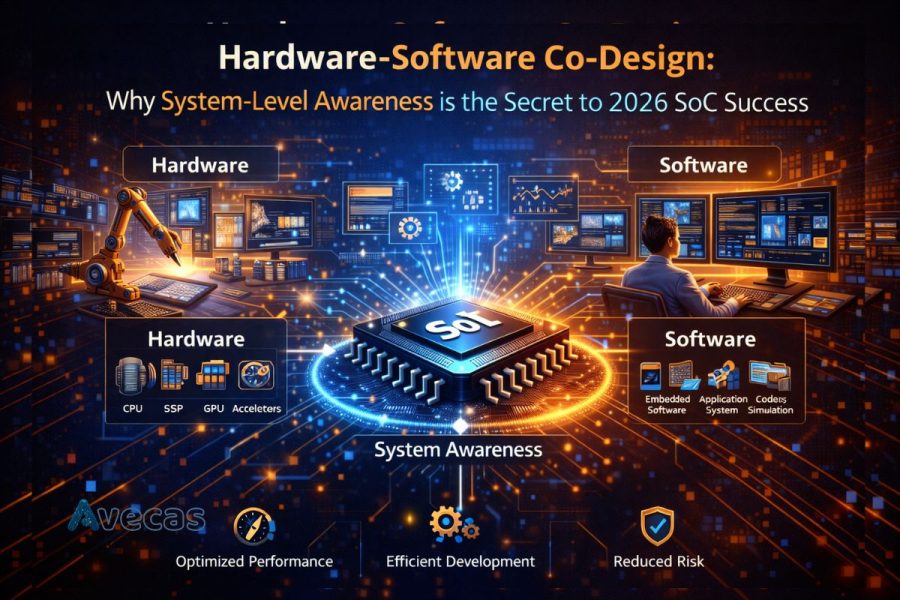
For decades, the semiconductor industry operated in functional silos. The hardware team would spend eighteen months architecting a “general-purpose” System-on-Chip (SoC), optimizing for peak clock speeds and theoretical throughput. Once the silicon was finalized, they would “throw it over the wall” to the software team, who were then tasked with making the code run efficiently on a fixed piece of hardware.
In 2026, this fragmented approach is no longer just inefficient, it is a recipe for project failure. As we push into the era of specialized AI accelerators, autonomous vehicles, and ultra-low-power edge devices, the traditional boundaries between bits and atoms have dissolved. The secret to success in the current landscape is Hardware-Software Co-Design, powered by deep System-Level Awareness.
Defining System-Level Awareness
System-Level Awareness is the ability to view the SoC not as an isolated component, but as one part of a larger, living ecosystem. It requires hardware architects to understand the specific software workloads—such as transformer-based AI models or real-time sensor fusion, that will run on the chip. Conversely, it requires software developers to understand the underlying physical constraints, from memory bandwidth bottlenecks to thermal throttling limits.
When you master the 6 essential steps in chip development, you begin to see that the most critical decisions happen long before the first line of RTL is written. Success today is defined by how well the hardware “footprint” matches the software “intent.”
Why 2026 Demands Co-Design
The drive toward co-design is being fueled by three primary technical pressures:
1. The Rise of Domain-Specific Architectures (DSAs)
General-purpose computing is reaching its limit. To get a 10x improvement in performance-per-watt, we can no longer rely on Moore’s Law alone. We must build Domain-Specific Architectures. This means designing hardware that is “opinionated”, it is built specifically to accelerate a particular class of software. You cannot build an effective DSA without a deep, co-designed understanding of the algorithms it will execute.
2. The Memory and Power Wall
Data movement is now more expensive than data processing. In modern AI applications, moving a byte from external memory to the processor consumes significantly more power than the actual computation. Co-design allows architects to implement “software-managed” memories or custom cache hierarchies that align perfectly with the software’s data access patterns, effectively breaking the memory wall.
3. Complexity in Verification
The more specialized a chip becomes, the harder it is to verify. Traditional hardware verification focuses on whether the logic matches the spec. But in a co-design model, verification also asks: “Does this hardware effectively run the target software stack?” This integrated approach is essential for modern DFT Verification & Validation workflows, where the goal is to ensure the entire system, not just the gate-level logic—is robust and reliable.
The Shift Toward Virtual Prototyping
One of the most significant shifts in Hardware-Software Co-Design is the move toward “left-shifting” development using virtual prototypes. In the past, software teams had to wait for “first silicon” to begin deep optimization. Today, high-fidelity digital twins and hardware-emulation platforms allow software developers to start writing and profiling their code months before a single wafer is processed.
This “circular” feedback loop is revolutionary. If the software team finds that a particular neural network layer is running slowly on the virtual model, the hardware team can still adjust the data paths or add a dedicated hardware accelerator. This level of agility is what allows 2026’s leading SoC firms to hit their performance targets on the first spin.
Breaking the Organizational Silos
Perhaps the greatest challenge in implementing Hardware-Software Co-Design isn’t technical, it’s organizational. It requires a cultural shift where hardware and software engineers speak the same language.
In a co-design environment, the “specification” is no longer a static document; it is an evolving dialogue. Designers must be willing to trade hardware area for software simplicity, and software engineers must be willing to optimize their algorithms for specific hardware constraints. This holistic view ensures that the final product isn’t just a collection of powerful components, but a cohesive system optimized for its specific mission.
The Strategic Edge for Semiconductor Services
For semiconductor service providers, providing “System-Level Awareness” is a massive competitive differentiator. Clients are no longer just looking for someone to do the layout; they are looking for partners who can help them define the architecture.
A service firm that understands the full stack from the underlying physics of the transistor to the high-level software framework can provide insights that save millions of dollars in wasted R&D. They can identify where a chiplet-based approach makes more sense than a monolithic design, or where a custom RISC-V instruction might eliminate a software bottleneck.
Looking Ahead: The Autonomous System
As we look toward the future, the integration of AI will further automate the co-design process. We are moving toward a world where AI-driven EDA tools can suggest hardware modifications based on software profiling data in real-time. However, the guiding hand of the human architect armed with system-level awareness will remain the most important factor in the design.
Conclusion: Silicon is Only as Good as the System
In 2026, the SoC is the heart of the system, but it doesn’t beat in a vacuum. The success of the next generation of semiconductors depends on our ability to bridge the gap between hardware and software. By embracing co-design, we move past the limitations of individual components and begin to build truly intelligent systems.
The era of the “general-purpose” chip is fading. The future belongs to those who design with the end-system in mind, ensuring that every gate, every line of code, and every watt of power is perfectly aligned toward a single goal.