

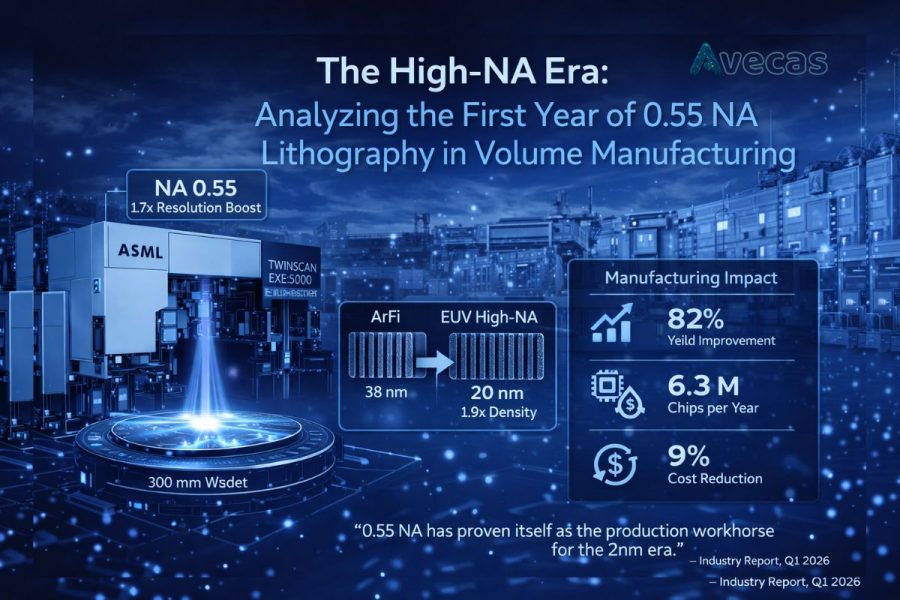
As of 2026, the semiconductor industry has crossed the threshold into the High-Numerical Aperture (High-NA) era. The deployment of the first production-grade scanners, specifically the ASML Twinscan EXE:5200, has shifted the conversation from laboratory feasibility to high-volume manufacturing (HVM) reality. For the leading-edge foundries currently pushing 2nm and 1.4nm (14A) processes, this technology is no longer an optional upgrade, it is the primary engine for density scaling.
The move from 0.33 NA to 0.55 NA represents a 67% increase in the lens’s ability to collect light, directly enabling the printing of features below 10nm without the need for complex multi-patterning schemes. However, the first year of volume production has revealed that the “High-NA dividend” comes with significant structural and economic prerequisites.
The Anatomy of a $30 Billion Fab
The financial blueprint of a 2026 leading-edge facility has been entirely rewritten by the requirements of High-NA tools. Each scanner, valued at approximately $400 million, requires a massive footprint that has forced foundries to abandon traditional fab layouts.
The sheer physical size and weight of these systems have led to “Double-Digit Billion” CapEx (Capital Expenditure) projects. Foundries have had to invest in specialized vibration-damping floors and expanded ceiling heights to accommodate the anamorphic optics and the massive vacuum chambers required. The cost of entry for the Angstrom era has effectively narrowed the field to a small group of players capable of amortizing these investments over millions of units.
Technical Performance: Throughput vs. Precision
The first year of HVM has provided critical data on the throughput capabilities of these systems. While early concerns suggested that the reduced field size (half-field) would cripple productivity, the reality in 2026 is more nuanced.
- Single-Patterning Efficiency: By eliminating the need for triple or quadruple EUV patterning on critical layers, foundries are seeing a significant reduction in cycle time. This translates to wafers moving through the fab 20% to 30% faster than they would on standard EUV lines for the same feature density.
- The Stitching Challenge: Because the EXE:5200 uses anamorphic lenses with different magnification ratios, the exposure field is halved. For large-die AI accelerators, this has mandated “field stitching,” where two exposures are joined with nanometer-level precision. Early yields in 2026 show that while stitching is viable, it requires a higher level of overlay control than previously anticipated.
Materials Science: The Metal-Oxide Resist Shift
The success of High-NA is inextricably linked to the chemicals that coat the wafer. In 2026, traditional chemically amplified resists (CAR) have hit a resolution limit due to “stochastics”—the random variation in photon arrival.
To counter this, the industry has widely adopted Metal-Oxide Resists (MOR). These materials provide a higher absorption cross-section for EUV photons, enabling sharper contrast and lower line-edge roughness (LER) at the 8nm and 5nm levels. The first year of mass production has shown that while MOR improves resolution, it requires specialized track equipment and developer chemistry, adding another layer of complexity to the fab’s chemical supply chain.
Economic Lessons: The Cost Per Transistor
The ultimate metric for 2026 is the cost per yielding transistor. High-NA was criticized for being too expensive, but the rising complexity of “stochiastic-limited” multi-patterning on 0.33 NA systems proved to be the more expensive path.
Data from 18A and 2nm pilot lines indicates that High-NA becomes economically superior at the 1.4nm node. The ability to print a single, high-fidelity layer reduces the defect density associated with multiple alignments, leading to higher final yields. In a market where AI demand is driving volumes, the higher yield and faster cycle time are proving to be worth the initial $400 million investment per tool.
Conclusion: The New Standard for the Angstrom Era
The first year of High-NA EUV in mass production has solidified its role as the gatekeeper of sub-2nm silicon. The industry has learned that while the physical and financial hurdles are immense, the benefits of single-exposure resolution are the only path forward for high-density logic and memory.
As we look toward the end of 2026, the focus is shifting from tool installation to “process-window” optimization. The foundation has been laid, the $30 billion fabs are humming, and the first wave of 14A consumer silicon is proving that the transition to 0.55 NA was the necessary pivot to keep the industry’s scaling roadmap on track.