

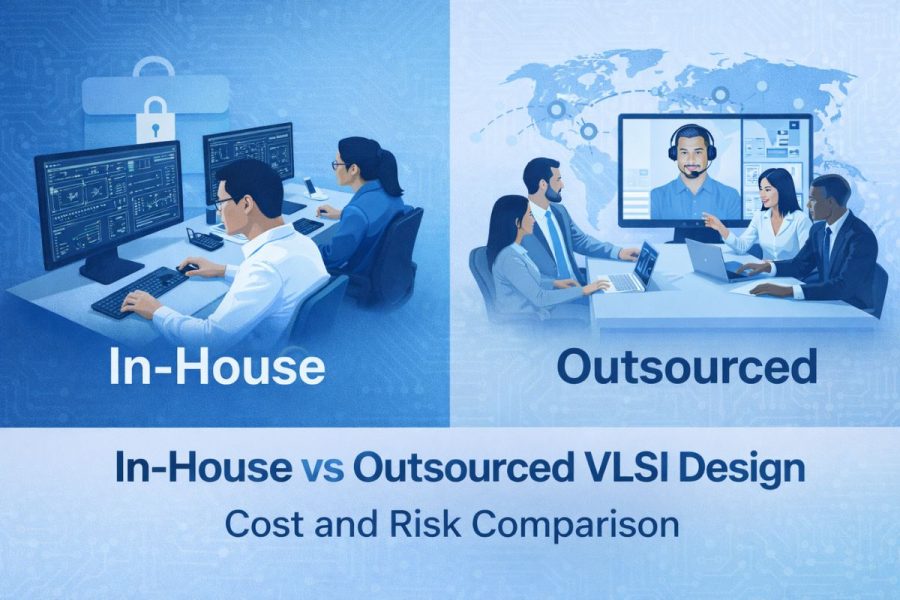
As semiconductor products become more complex and time-to-market pressures increase, companies face a crucial strategic decision: should VLSI design be handled in-house or outsourced to external partners? Both approaches have distinct advantages, costs, and risks. The right choice depends on business goals, technical requirements, timelines, and long-term scalability.
Understanding the trade-offs between in-house and outsourced VLSI design can help organizations make smarter, more cost-effective decisions while minimizing technical and operational risks.
Understanding In-House VLSI Design
In-house VLSI design means building and maintaining an internal team responsible for chip architecture, RTL design, verification, physical design, and validation.
Advantages of In-House VLSI Design
One of the biggest benefits is full control over the design process. Internal teams have direct access to product requirements, system architects, and software teams, leading to faster decision-making and better alignment with business objectives.
In-house teams also provide:
- Strong protection of intellectual property
- Better customization for proprietary products
- Easier collaboration across departments
- Long-term knowledge retention
For companies developing core technologies or differentiated silicon products, in-house design can become a strategic asset.
Cost Challenges of In-House Teams
While control is a major advantage, cost is the biggest challenge. In-house VLSI design involves:
- High salaries for skilled engineers
- Recruitment and retention expenses
- Continuous training on new tools and nodes
- Expensive EDA licenses and infrastructure
These fixed costs remain even during periods of low project activity, making in-house teams expensive for startups and mid-sized companies.
Understanding Outsourced VLSI Design
Outsourced VLSI design involves partnering with specialized design service companies or offshore teams that provide design expertise on a project or contract basis.
Advantages of Outsourcing VLSI Design
Outsourcing offers flexibility and cost efficiency, especially for companies with fluctuating workloads or limited internal expertise.
Key benefits include:
- Lower upfront investment
- Access to experienced specialists
- Faster project ramp-up
- Ability to scale resources as needed
- Reduced infrastructure and tool costs
Outsourcing is particularly attractive for companies entering new markets, using advanced nodes, or developing non-core silicon components.
Cost Benefits of Outsourcing
Instead of fixed salaries and long-term overhead, outsourcing converts design expenses into variable project-based costs. This helps companies manage budgets more predictably and reduces financial risk.
However, lower cost does not always mean lower risk, which brings us to the next important consideration.
Risk Comparison: In-House vs Outsourced
Intellectual Property Risk
In-house design offers the highest level of IP security. Sensitive architecture details, algorithms, and trade secrets remain within the organization.
Outsourcing introduces IP exposure risks, especially when working with multiple vendors or overseas teams. Strong contracts, NDAs, and access controls are essential to mitigate this risk.
Quality and Communication Risk
Internal teams benefit from shared culture, real-time collaboration, and deep product understanding. Outsourced teams may face challenges related to:
- Time zone differences
- Communication gaps
- Misinterpretation of specifications
Clear documentation, well-defined deliverables, and regular technical reviews are critical to maintaining quality when outsourcing.
Schedule and Dependency Risk
In-house teams offer better control over schedules and priorities. Outsourced projects may experience delays if vendors handle multiple clients or face resource constraints.
However, experienced outsourcing partners often bring proven methodologies and mature processes that can actually reduce schedule risk when managed properly.
Hybrid Model: A Practical Middle Ground
Many semiconductor companies now adopt a hybrid approach, combining in-house leadership with outsourced execution.
Typical hybrid strategies include:
- Keeping architecture and system design in-house
- Outsourcing RTL implementation or verification
- Using external teams for physical design or DFT
- Retaining final sign-off internally
This model balances cost efficiency with control and significantly reduces risk.
Long-Term Business Considerations
Choosing between in-house and outsourced VLSI design is not just a technical decision—it’s a business strategy.
In-house design is better suited for:
- Companies with long-term silicon roadmaps
- High-volume or proprietary products
- Strong capital investment capability
Outsourcing works best for:
- Startups and emerging companies
- Short-term or specialized projects
- Rapid prototyping and proof-of-concept designs
The decision may also change over time as products mature and business priorities evolve.
Industry Perspective on Outsourcing Trends
According to industry analysts, the global semiconductor design services market continues to grow as companies seek flexibility and faster innovation. Leading EDA vendors and industry bodies acknowledge outsourcing as a critical part of modern chip development.
For an industry overview on semiconductor design services, you can refer to this resource by Synopsys:
https://www.synopsys.com/design-services.html
Final Thoughts
There is no universal answer to whether in-house or outsourced VLSI design is better. Each approach has its own cost structure, risks, and strategic benefits.
Organizations that carefully assess their technical complexity, budget constraints, IP sensitivity, and long-term goals can choose the right model—or a hybrid approach—that maximizes efficiency while minimizing risk.
In today’s competitive semiconductor landscape, the smartest companies are not choosing sides. They are choosing flexibility, clarity, and informed decision-making.