

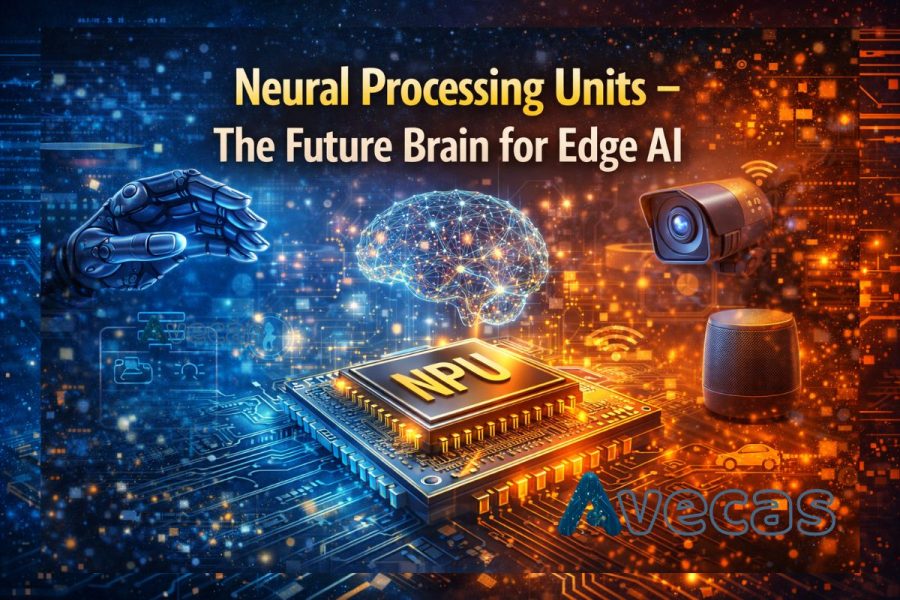
Artificial intelligence is rapidly moving away from centralized cloud systems toward the edge, where data is generated and decisions must be made instantly. From smart cameras and autonomous machines to wearable health devices and industrial sensors, edge AI is redefining how intelligent systems operate. At the heart of this transformation lies a new class of silicon: Neural Processing Units, commonly known as NPUs.
NPUs are purpose-built processors designed to execute AI workloads efficiently, making them the future brain for edge intelligence.
Why Edge AI Needs Specialized Processing
Traditional AI workloads were initially handled by CPUs and later accelerated by GPUs. While GPUs offer massive parallelism, they are often power-hungry and unsuitable for edge environments where energy efficiency, latency, and form factor are critical.
Edge AI systems must process data locally, respond in real time, and operate within strict power and thermal limits. This creates the need for hardware that is optimized specifically for neural network inference rather than general-purpose computing.
NPUs address this challenge by delivering high AI performance at significantly lower power consumption.
What Is a Neural Processing Unit?
A Neural Processing Unit is a specialized processor architecture designed to accelerate machine learning and deep learning workloads. Unlike CPUs, which are optimized for sequential tasks, or GPUs, which are optimized for graphics and parallel compute, NPUs are tailored for neural network operations such as matrix multiplication, convolution, and activation functions.
Key characteristics of NPUs include:
• Highly parallel compute units optimized for AI workloads
• Dedicated memory architectures to reduce data movement
• Low power consumption for continuous operation
• Deterministic performance for real-time inference
These features make NPUs ideal for deploying AI models at the edge.
NPUs vs CPUs and GPUs at the Edge
While CPUs remain essential for control logic and system orchestration, they struggle to efficiently execute AI models, especially as model complexity grows. GPUs offer strong AI performance but often exceed power budgets and introduce latency challenges in edge environments.
NPUs strike a balance by delivering AI acceleration with minimal energy overhead. They enable always-on intelligence, making it possible to run AI models continuously without draining batteries or requiring active cooling.
This efficiency is a key reason why NPUs are becoming a core component of modern edge SoCs.
Enabling Real-Time Intelligence at the Edge
One of the most significant advantages of NPUs is their ability to enable real-time decision making. Edge applications often require immediate responses without relying on cloud connectivity.
Common edge AI use cases powered by NPUs include:
• Computer vision in smart cameras and surveillance systems
• Voice recognition and natural language processing in smart assistants
• Predictive maintenance in industrial automation
• Object detection and sensor fusion in autonomous systems
By processing data locally, NPUs reduce latency, improve reliability, and enhance data privacy.
Power Efficiency and Thermal Advantages
Edge devices operate under strict power and thermal constraints. Excessive power consumption leads to heat generation, reduced device lifespan, and increased system cost.
NPUs are designed with energy efficiency as a top priority. By minimizing unnecessary computations and optimizing data flow, they achieve high performance per watt. This makes them suitable for battery-powered devices, fanless systems, and compact form factors.
In many applications, NPUs enable AI capabilities that would otherwise be impractical using conventional processors.
The Role of NPUs in Heterogeneous SoC Design
Modern edge platforms increasingly rely on heterogeneous system-on-chip architectures. These SoCs integrate CPUs, GPUs, NPUs, and other accelerators on a single chip, each handling workloads they are best suited for.
In this architecture:
• CPUs manage control, scheduling, and system tasks
• GPUs handle graphics and parallel compute workloads
• NPUs execute AI inference efficiently
This division of labor improves overall system performance while keeping power consumption under control. NPUs play a central role in this balanced compute strategy.
Software Ecosystem and AI Model Optimization
Hardware alone is not enough to drive edge AI adoption. A strong software ecosystem is essential. NPUs are supported by optimized compilers, AI frameworks, and runtime environments that translate trained models into efficient hardware execution.
Model optimization techniques such as quantization, pruning, and operator fusion are commonly used to adapt AI models for NPU execution. These optimizations reduce memory footprint and computational load without significantly impacting accuracy.
As tooling matures, deploying AI models on NPUs is becoming faster and more accessible for developers.
Industry Adoption and Market Momentum
NPUs are already being integrated into a wide range of products across industries. Consumer electronics, automotive systems, industrial automation, healthcare devices, and smart infrastructure are all adopting edge AI solutions powered by NPUs.
This adoption is driven by the growing demand for intelligent, autonomous, and connected systems that operate reliably without constant cloud interaction. As AI models become more sophisticated, the importance of dedicated neural processing hardware will continue to grow.
What the Future Holds for NPUs
The future of NPUs lies in deeper integration, higher efficiency, and greater programmability. Advances in semiconductor technology will enable more powerful NPUs within the same power envelope, supporting increasingly complex AI workloads at the edge.
We can also expect tighter coupling between NPUs and sensors, memory, and communication interfaces, enabling end-to-end intelligent systems optimized from data capture to inference.
Final Thoughts
Neural Processing Units are becoming the foundation of edge AI. By delivering high-performance intelligence with low power consumption, they enable real-time decision making across a wide range of applications.
For semiconductor innovators and engineering leaders like Avecas, NPUs represent a critical opportunity to shape the future of edge intelligence. As AI continues moving closer to the source of data, NPUs will serve as the brains that power the next generation of smart, autonomous systems.