

Introduction
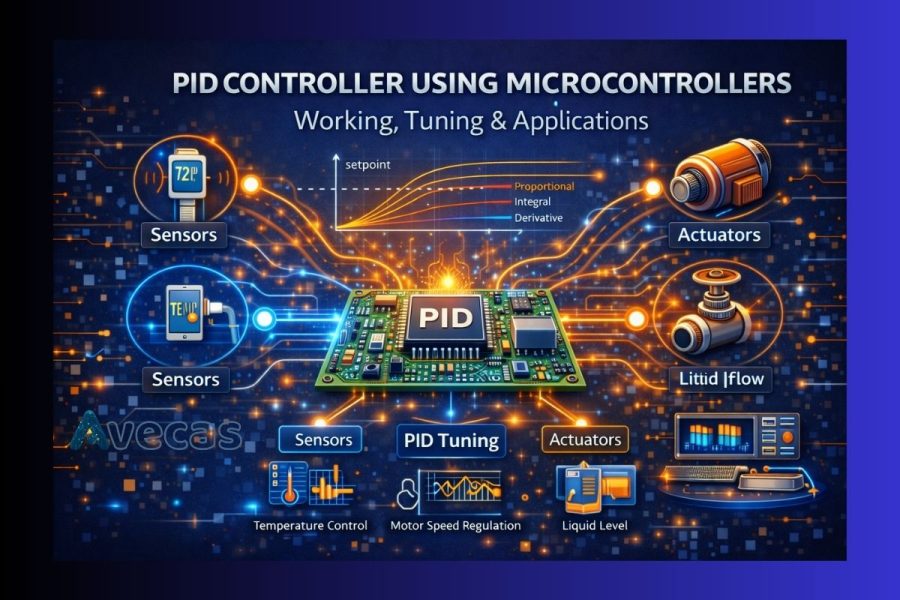
In automated systems where control precision matters, a PID controller stands out as one of the most reliable and effective control strategies. When implemented using microcontrollers, a PID controller can manage variables like temperature, speed, position and flow, providing smooth and stable operation in embedded applications.
In this article, we explore what a PID controller is, how it works with microcontrollers, key implementation steps, tuning techniques, and common use cases in embedded control systems.
What Is a PID Controller
A PID controller is a control algorithm that stands for Proportional, Integral and Derivative control. It continuously calculates the difference between a desired target value (setpoint) and the actual value (process variable), and then adjusts the system input to minimize this error over time.
When connected to sensors and actuators via a microcontroller, a PID controller becomes a smart control system that can react to changes quickly and keep system performance stable.
How PID Control Works
The PID algorithm uses three components to compute corrective actions:
1. Proportional Control
Proportional control produces an output proportional to the current error, which helps correct large deviations quickly.
2. Integral Control
Integral control sums past errors over time to eliminate long-term offset between the target and actual values.
3. Derivative Control
Derivative control predicts future error based on how fast the error is changing, helping reduce overshoot and improve response stability.
The combined effect of these three terms creates smooth, accurate, and responsive control behavior.
Why Use Microcontrollers in PID Systems
Microcontrollers serve as the processing core for embedded PID systems due to their compact size, low cost, real-time performance, and versatile I/O support. With built-in timers, ADC channels and communication interfaces, microcontrollers can:
- Read sensor data accurately
- Apply PID calculations in real time
- Generate appropriate control signals for actuators
- Log performance for monitoring or debugging
This makes them ideal for implementing PID control in industrial controllers, robotics, HVAC systems and many other applications.
Key Components of a Microcontroller-Based PID System
To build a PID controller using a microcontroller, the following elements are typically used:
Sensors
Sensors capture real world measurements such as temperature, speed, pressure or position, providing feedback data to the controller.
Microcontroller Unit
The microcontroller executes the PID algorithm in each control cycle, using timer interrupts or scheduled loops to ensure consistent computation.
Actuators
Actuators such as motors, heaters or valves receive output commands from the microcontroller to alter the system state.
Power and Signal Conditioning
Power electronics, filtering and conditioning circuits ensure the microcontroller and sensors receive stable signals for accurate control.
Implementation Steps
Here’s a general process for developing a PID controller on a microcontroller:
1. Define Control Objectives
Determine the variable you want to control (temperature, speed) and the desired setpoint.
2. Integrate Sensors and Actuators
Connect appropriate sensors to measure the process variable, and actuators capable of adjusting the output.
3. Develop PID Algorithm
Translate the mathematical representation of PID into efficient embedded code that runs repeatedly at fixed intervals.
4. Tune PID Parameters
Adjust the proportional, integral and derivative gains to achieve stable, responsive control (we’ll explore tuning below).
5. Test and Debug
Monitor the control system under various conditions and refine the algorithm to address overshoot, delay or oscillations.
PID Tuning Techniques
Choosing the right values for proportional, integral and derivative gains is crucial for optimal performance. Common tuning approaches include:
Manual Tuning
Manually increase or decrease gains while observing system response. Begin with proportional control, then introduce integral and derivative actions.
Ziegler-Nichols Method
A systematic method that uses step responses or sustained oscillations to calculate PID gains based on empirical formulas.
Software-Assisted Tuning
Modern microcontroller IDEs provide tools to analyze system performance and suggest appropriate gains automatically.
Proper tuning ensures the system responds quickly without overshooting or oscillating, and keeps the process variable close to the target.
Real-World Applications of PID Controllers
PID controllers implemented with microcontrollers are widely used in:
Temperature Control Systems
Managing heaters and coolers in ovens, HVAC units, or industrial furnaces.
Motor Speed Regulation
Controlling the rotational speed of DC or stepper motors in robotics, manufacturing and automation.
Fluid Flow Control
Keeping flow rates stable in pumps, dosing systems and chemical processing.
Position Control in Robotics
Ensuring precise movement and stability in robotic arms or automated guided vehicles.
Power Supply Regulation
Maintaining stable voltage or current output in power electronics and battery systems.
Benefits of PID Control With Microcontrollers
When implemented correctly, PID controllers offer:
- Stable and accurate performance
- Reduced overshoot and oscillations
- Faster settling time
- Flexible tuning for varied applications
- Cost-effective embedded implementation
These advantages make PID control a preferred choice for embedded systems that require consistent and reliable control behavior.
Conclusion
A PID controller using a microcontroller is a powerful and practical solution for modern automation and control systems. By combining real-time feedback, smart algorithms and responsive outputs, PID control can optimize performance across a wide range of applications from industrial automation to smart appliances.
With careful design, proper tuning and system testing, embedded PID systems deliver reliable control that meets performance goals and improves overall system quality.