

For decades, the semiconductor industry followed a predictable path: make transistors smaller to pack more power onto a single piece of silicon. However, as we approach the physical limits of atomic-scale manufacturing, the “monolithic” approach, where every component is on one large die is becoming prohibitively expensive and technically challenging.
Enter the era of Chiplets and Heterogeneous Integration. This modular approach to semiconductor manufacturing is no longer just a laboratory concept; it is the new standard for high-performance computing, AI, and automotive electronics.
What are Chiplets?
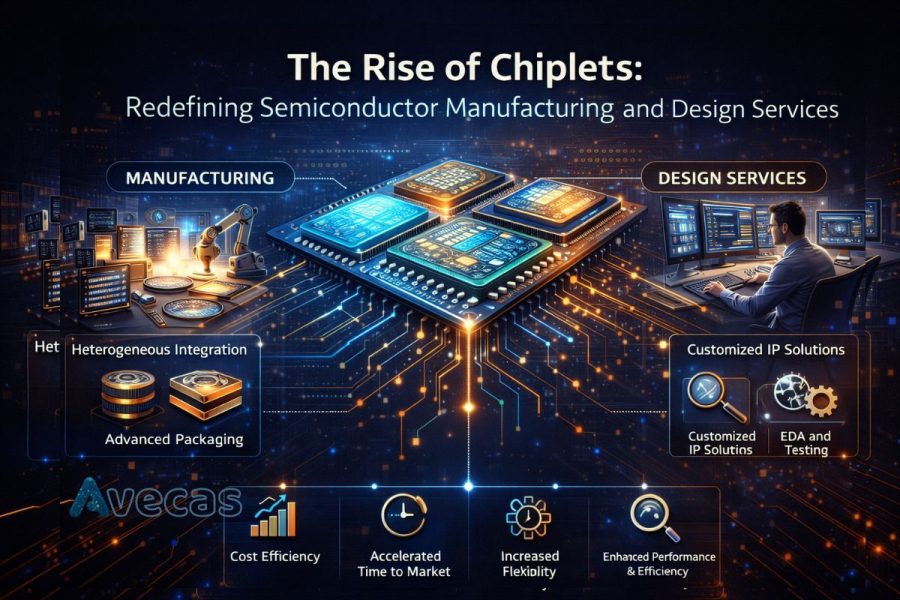
Instead of designing one massive, complex chip, engineers are now breaking designs into smaller, functional blocks called chiplets. These individual pieces are manufactured separately, sometimes even using different process nodes, and then stitched together using advanced packaging techniques.
This shift is a game-changer for semiconductor services providers. It allows for higher yields, lower costs, and faster time-to-market. When you understand the 6 essential steps in chip development, it becomes clear that integrating multiple dies requires a higher level of precision in the early design and verification stages.
The Impact on Design and Verification
The move to chiplet-based architectures introduces new complexities. Interconnects between chiplets must be incredibly fast and reliable. This has placed a renewed focus on DFT (Design for Test) Verification & Validation.
Testing a monolithic chip is straightforward compared to testing a multi-die system. In a chiplet ecosystem, ensuring that “Known Good Die” (KGD) are integrated correctly is paramount. This is where specialized DFT Verification & Validation services become the backbone of a successful product launch. Without rigorous validation, the cost of a failure after packaging can be catastrophic.
Advanced Packaging: The New Frontier
Semiconductor manufacturing is no longer just about the front-end wafer fabrication. The “back-end”—packaging—has become a source of massive innovation. Technologies like CoWoS (Chip on Wafer on Substrate) and 3D-IC are enabling levels of performance that were previously thought impossible.
As nations compete for dominance in this space, as seen in the global shift in semiconductor nationalism, the ability to master advanced packaging will define the leaders of the next decade. For service-oriented firms, this means providing robust Production Test & Silicon Bring-Up Support that can handle the intricacies of 3D stacked dies and high-speed thermal management.
Why the India Semiconductor Mission 2.0 Matters
This technological shift aligns perfectly with recent policy updates. The India Semiconductor Mission 2.0 specifically emphasizes building a robust ecosystem that includes ATMP (Assembly, Testing, Marking, and Packaging). By focusing on these modular technologies, India is positioning itself to be a hub for the next generation of semiconductor services.
Conclusion: Embracing the Modular Revolution
The transition to chiplets represents the most significant architectural change in the semiconductor industry in twenty years. For companies involved in design, verification, and testing, it offers a unique opportunity to provide high-value expertise in a complex, evolving market.
As we move toward a future where “system-in-package” becomes the norm, the integration of cutting-edge design services with rigorous testing protocols will be the key to unlocking the next level of silicon performance.