

Introduction
The semiconductor industry is entering a new era where complexity, scale, and time-to-market pressures are higher than ever. As chips grow more advanced and design cycles become tighter, traditional workflows struggle to keep pace. This challenge has opened the door for a new form of artificial intelligence known as Agentic AI.
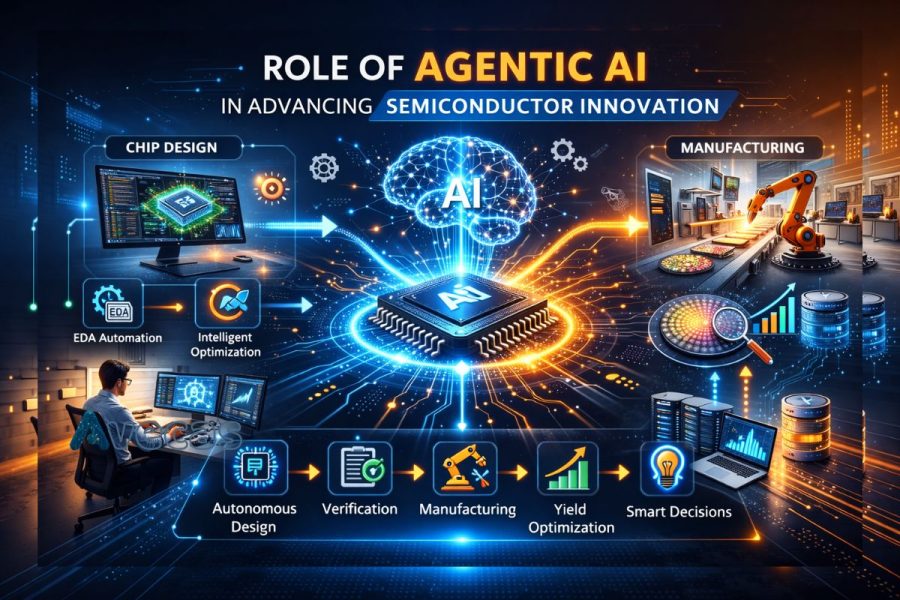
Unlike conventional AI systems that simply respond to instructions, agentic AI systems act autonomously. They observe, decide, execute tasks, learn from outcomes, and continuously improve. In semiconductor innovation, agentic AI is emerging as a powerful force that accelerates design, improves manufacturing efficiency, and enables smarter decision making across the entire chip lifecycle.
What Is Agentic AI
Agentic AI refers to AI systems composed of intelligent agents that can operate independently toward defined goals. These agents do not just analyze data, they actively plan actions, execute workflows, adapt strategies, and collaborate with other agents when needed.
In the semiconductor context, agentic AI can manage complex tasks such as optimizing chip layouts, running verification cycles, analyzing yield data, or balancing performance and power tradeoffs, all with minimal human intervention.
Why Semiconductor Innovation Needs Agentic AI
Modern semiconductor development involves thousands of interdependent decisions across design, verification, fabrication, and testing. Human driven processes alone are no longer sufficient due to:
- Increasing chip complexity and transistor counts
- Shorter product development cycles
- Rising costs of design errors and rework
- Massive volumes of design and manufacturing data
Agentic AI addresses these challenges by introducing autonomous intelligence that can operate continuously, explore vast design spaces, and make optimized decisions faster than traditional methods.
Agentic AI in Semiconductor Design
Autonomous Design Exploration
In term of Semiconductor Design, Agentic AI can evaluate millions of design variations, exploring performance, power, and area tradeoffs autonomously. Instead of engineers manually tuning parameters, AI agents generate, test, and refine designs until optimal results are achieved.
Intelligent Floorplanning and Placement
AI agents can dynamically adjust floorplans, component placement, and routing strategies based on real time feedback from timing, congestion, and power analysis.
Faster Design Convergence
By learning from previous iterations, agentic AI reduces trial and error, leading to faster convergence and fewer late stage design changes.
Agentic AI in Verification and Testing
Verification is one of the most time consuming phases in chip development. Agentic AI significantly improves this process.
Self Directed Verification Strategies
AI agents can identify untested scenarios, generate new test cases, and prioritize coverage gaps without manual intervention.
Adaptive Debugging
When failures occur, agentic AI analyzes root causes, suggests fixes, and validates improvements automatically, reducing debugging cycles.
Smarter Test Optimization
Agentic systems can balance test coverage and execution time, ensuring high quality without excessive testing cost.
Agentic AI in Semiconductor Manufacturing
Yield Optimization
Agentic AI analyzes fabrication data to detect subtle patterns that affect yield. It autonomously adjusts process parameters to improve consistency and output quality.
Predictive Maintenance
By monitoring equipment behavior, AI agents predict failures before they occur, reducing downtime and increasing fab efficiency.
Process Control Automation
Agentic AI continuously fine tunes manufacturing conditions, adapting to variations in materials or environmental factors.
Role in Backend and Physical Design
Backend semiconductor flows are highly complex and iterative, making them ideal for agentic AI adoption.
- Autonomous timing closure optimization
- Intelligent power integrity and thermal analysis
- Automated ECO generation and validation
- Continuous improvement across design nodes
Agentic AI reduces manual effort while improving accuracy and predictability in backend design stages.
Collaboration Between Human Engineers and Agentic AI
Agentic AI does not replace engineers, it enhances their capabilities.
- Engineers define goals and constraints
- AI agents explore solutions and execute workflows
- Humans review insights, validate outcomes, and guide strategy
This collaboration allows engineers to focus on innovation and architecture, while AI handles repetitive and data intensive tasks.
Benefits of Agentic AI for Semiconductor Innovation
Adopting agentic AI delivers measurable advantages:
- Faster time to market
- Reduced design and manufacturing costs
- Improved chip performance and power efficiency
- Higher yield and reliability
- Scalable innovation across product lines
These benefits are becoming essential for companies competing in advanced semiconductor markets.
Challenges and Considerations
While powerful, agentic AI adoption requires careful planning:
- Integration with existing EDA and manufacturing tools
- Trust and validation of AI driven decisions
- Data quality and security management
- Skill development for AI guided workflows
Successful implementation depends on combining strong AI systems with robust engineering oversight.
Future Outlook
As semiconductor complexity continues to grow, agentic AI will become a foundational technology. Future systems will feature networks of specialized AI agents collaborating across design, verification, manufacturing, and testing stages.
This evolution will enable truly autonomous semiconductor workflows, where innovation accelerates continuously with minimal friction.
Conclusion
Agentic AI is reshaping how semiconductor innovation happens. By enabling autonomous decision making, continuous optimization, and intelligent collaboration, it addresses the growing challenges of modern chip development.
From design exploration and verification to manufacturing and backend optimization, agentic AI empowers semiconductor teams to innovate faster, smarter, and more efficiently. As the industry moves forward, agentic AI will play a central role in defining the next generation of semiconductor breakthroughs.