

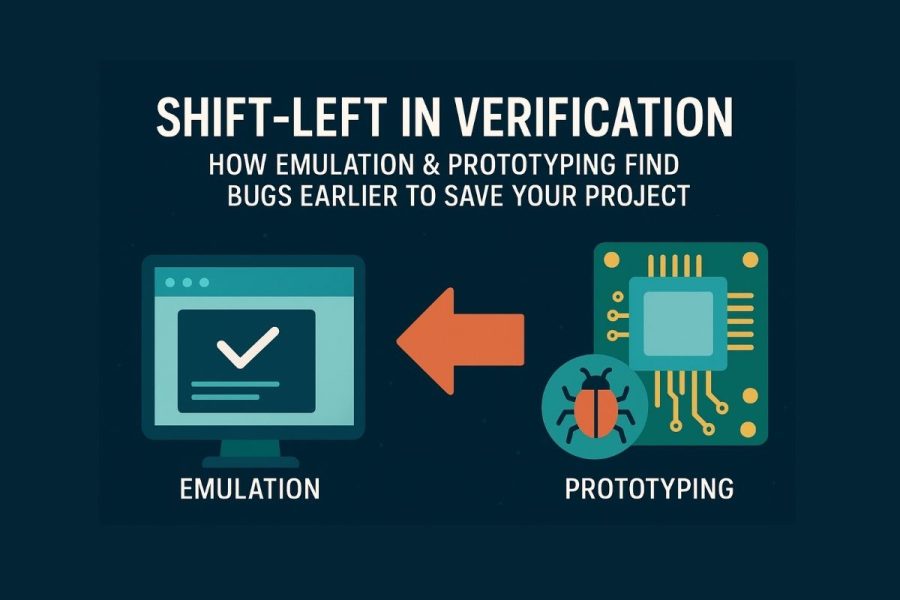
In the high-stakes race to market for complex SoCs and ASICs, a late-stage bug discovery isn’t just a setback—it’s a potential project killer. A bug found at the tape-out stage can cost millions of dollars in re-spins, not to mention the irreplaceable loss of time and market window.
For decades, the traditional verification flow has been largely reactive. RTL is written, simulated, and then bugs are found and fixed in a lengthy, iterative cycle. But what if you could be proactive? What if you could “shift-left” and uncover system-level, hardware-dependent bugs months before you traditionally would?
This is no longer a theoretical question. At Avecas Technologies, we are helping our clients implement this exact strategy, leveraging the immense power of emulation and prototyping to transform their verification outcomes.
What Does “Shift-Left” Really Mean in Verification?
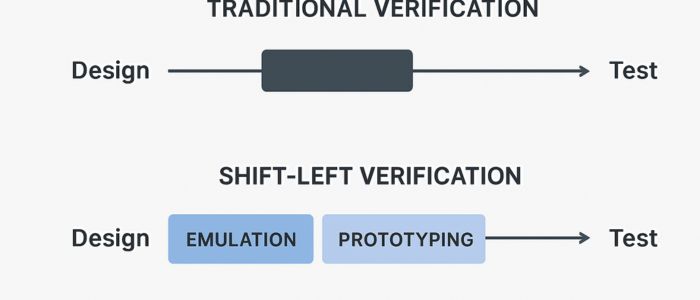
The term “Shift-Left” is a powerful metaphor. Imagine your project timeline from left (start/design) to right (tape-out/sign-off). Traditionally, complex system validation happened on the far “right,” just before tape-out.
Shifting left means moving these critical verification activities earlier (“left”) in the design cycle. The goal is to find and fix bugs when they are cheaper and easier to resolve, fundamentally reducing project risk and schedule uncertainty.
The Engine of Shift-Left: Emulation and Prototyping
While simulation is perfect for block-level testing, it is too slow for full-SoC verification with real software. This is where hardware-assisted verification platforms come in.
1. Emulation: The High-Visibility Powerhouse
Emulation uses arrays of processors (FPGAs or custom silicon) to create a hardware model of your design that runs orders of magnitude faster than simulation (MHz range).
- How it enables Shift-Left: Emulation allows you to boot an actual operating system (Linux, Android) and run massive software test suites against your RTL, weeks or months before silicon is available.
- What you find early: System-level deadlocks, memory map errors, performance bottlenecks, and hardware-software integration bugs that are impossible to catch in simulation.
2. Prototyping: The Real-World Validation Lab
Prototyping is also FPGA-based but is optimized for speed (often running at 10-100+ MHz) and is used to create a physical system for software development and final validation.
- How it enables Shift-Left: You can connect the prototype to real-world interfaces (Ethernet, USB, PCIe, sensors) and run actual application software in a real-time environment. This is the ultimate test before tape-out.
- What you find early: Latency issues, driver bugs, data throughput problems, and flaws in interaction with other system components.
The Tangible Benefits of a Shift-Left Strategy
Adopting this approach with emulation and prototyping isn’t just a technical choice; it’s a strategic business decision with clear ROI:
- Dramatic Cost Reduction: Fixing a bug during RTL design is 10x to 100x cheaper than fixing it after tape-out.
- Accelerated Time-to-Market: Parallelizing hardware and software development shaves months off the project schedule.
- Higher Quality Silicon: More cycles of testing with real software leads to a more robust and functional first-time-right silicon.
- Reduced Project Risk: Uncovering show-stopper bugs early eliminates last-minute surprises and re-spin chaos.
Implementing Shift-Left: A Practical Guide with Avecas
Shifting left is a cultural and methodological change. Here’s how we help our clients succeed:
- Early Planning: Integrate emulation/prototyping into your project plan from day one. Define what software will run and what scenarios must be tested.
- The Right Tool for the Job: Choose between emulation (for deep debug) and prototyping (for speed and real-world I/O). Often, they are used in tandem.
- Continuous Integration: Automate the flow from RTL synthesis to bringing up the platform. The goal is to get new RTL onto the emulator/prototype daily.
- Collaboration: Break down silos. Encourage verification engineers, software developers, and system architects to use the platform simultaneously.
For a deeper dive into the technical specifics of setting up these flows, our partners at ChipXpert have an excellent resource on their blog: The Engineer’s Guide to Hardware Emulation Setup.
How Avecas Technologies Empowers Your Shift-Left Journey
At Avecas Technologies, we understand that adopting these advanced methodologies can be daunting. Our team of seasoned experts provides end-to-end support:
- Methodology Consulting: We help you define the right shift-left strategy for your specific project needs and constraints.
- Emulation & Prototyping Platform Expertise: From setup and bring-up to optimization, we ensure you get the most out of your investment.
- Outsourced Verification Services: Leverage our expert team to run your shift-left verification campaigns, allowing your in-house team to focus on core design activities.
We don’t just provide services; we provide a partnership aimed at de-risking your most challenging projects.
Ready to shift your verification left and find bugs before they find you?
Contact Avecas Technologies today for a consultation. Let’s discuss how our Semiconductor Services can help you achieve faster tape-out with higher confidence.
Schedule Your Free Consultation Now
Explore our comprehensive Verification Services: ASIC / SoC Design Verification Services