

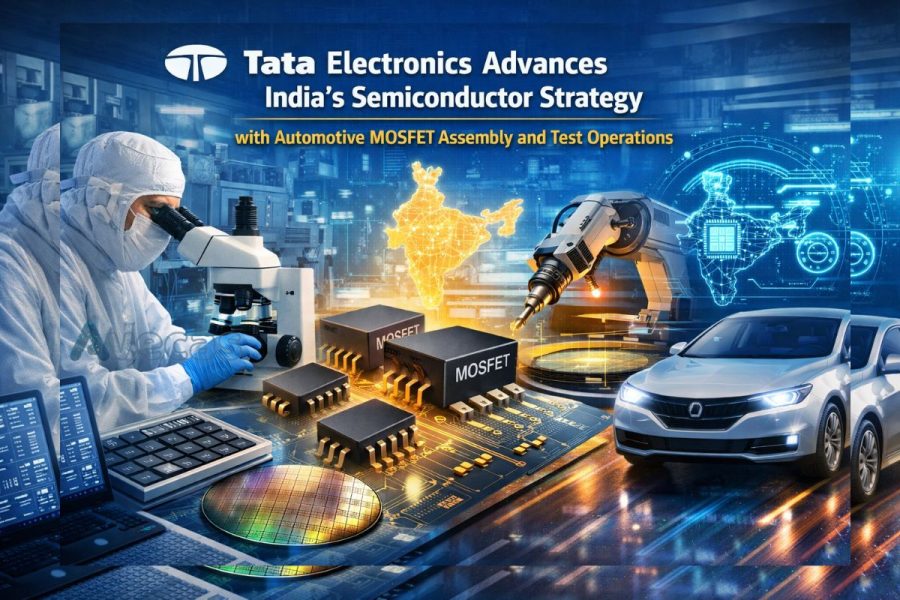
HOSUR, INDIA — In a strategic move that signals India’s deepening integration into the global semiconductor value chain, Tata Electronics has announced the commencement of assembly and test operations for automotive Power MOSFETs (Metal-Oxide-Semiconductor Field-Effect Transistors). This development marks a critical expansion for the company into the OSAT (Outsourced Semiconductor Assembly and Test) sector, specifically targeting the high-growth electric vehicle (EV) and industrial power electronics markets.
Strengthening the Mid-Stream Supply Chain
While much of the global semiconductor discourse focuses on front-end wafer fabrication at advanced nodes, the “back-end” of the process—assembly, testing, and packaging—remains a vital bottleneck. By establishing specialized lines for Automotive Grade MOSFETs, Tata Electronics is addressing a specific void in the regional supply chain.
For electronics engineers and supply chain managers, this move is significant. Automotive MOSFETs are the workhorses of power management, essential for:
- DC-DC Converters: Managing voltage transitions between battery systems.
- Inverter Stages: Controlling traction motors in electric drivetrains.
- On-board Chargers (OBC): Ensuring efficient energy intake during charging cycles.
Navigating the “Zero-Defect” Requirement
The automotive industry operates under a “zero-defect” mandate, governed by rigorous standards such as AEC-Q101. Unlike consumer-grade electronics, automotive power components must withstand extreme thermal cycling, mechanical vibration, and high-voltage stress over a 15-to-20-year lifespan.
Tata’s entry into this space involves sophisticated testing protocols, including:
- High-Temperature Reverse Bias (HTRB): Testing long-term stability under voltage stress.
- Thermal Shock Testing: Ensuring the integrity of the packaging and wire bonding.
- Dynamic Electrical Characterization: Verifying switching speeds and $R_{DS(on)}$ (on-resistance) efficiency.
For staff within the semiconductor industry, this represents a sophisticated shift in India’s manufacturing capability—moving beyond basic assembly into high-reliability power electronics that require precise calibration and advanced cleanroom environments.
Strategic Implications for Global OEMs
The global automotive industry is still reeling from the “just-in-time” supply chain failures of previous years. For European and American Original Equipment Manufacturers (OEMs), Tata’s new facility offers a vital “China Plus One” alternative.
By diversifying the geographical footprint of OSAT services, Tata provides semiconductor designers and “fabless” companies a way to de-risk their production. The proximity of these facilities to emerging EV manufacturing hubs in India further reduces lead times and logistics costs for power modules.
The Shift Toward Vertical Integration
This move is part of a broader vision for Tata Group, which aims to create a vertically integrated electronics ecosystem. With Tata Motors leading the Indian EV market and Tata Power building the charging infrastructure, Tata Electronics’ foray into MOSFET testing completes a circular economy of technology.
For professionals in the electronics background, this signifies a pivot in the Indian landscape: the transition from being a consumer of silicon to a critical node in its production. As the industry moves toward Silicon Carbide (SiC) and Gallium Nitride (GaN) for next-generation power density, Tata’s current investment in MOSFET infrastructure provides the foundational expertise required to scale into these wide-bandgap materials.