

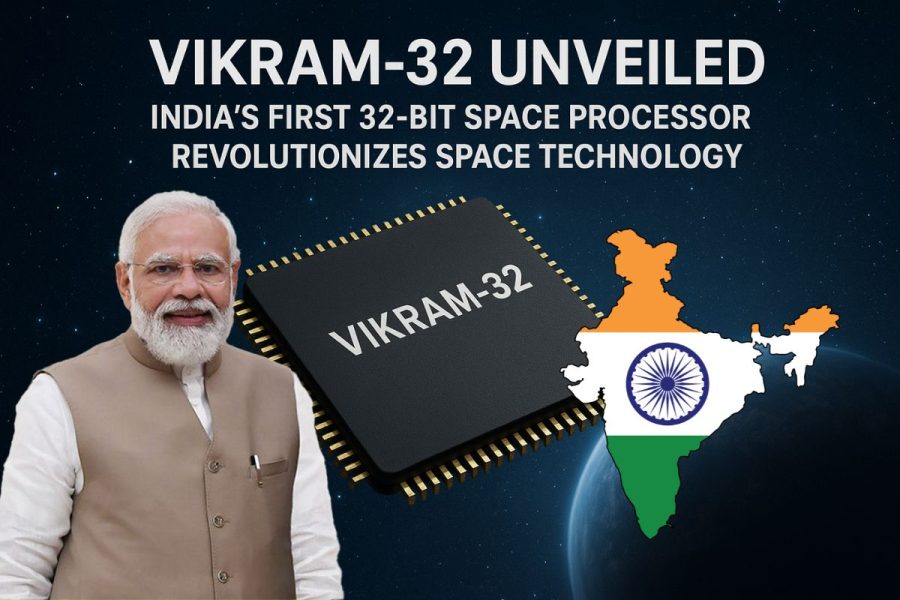
India has taken a giant leap in its space technology journey with the launch of the Vikram-32, the country’s first indigenously developed 32-bit microprocessor designed specifically for space applications. Unveiled by Union Minister Ashwini Vaishnaw at the Semicon India 2025 conference, this cutting-edge microchip was presented to Prime Minister Narendra Modi, marking a milestone in India’s semiconductor innovation. Developed by the Indian Space Research Organisation’s (ISRO) Semiconductor Laboratory (SCL) in Chandigarh, the Vikram-32 is engineered to thrive in the harsh conditions of space missions. Here’s a deep dive into the features, significance, and potential of this groundbreaking processor.
What is the Vikram-32 Processor?
The Vikram-32 is the successor to the VIKRAM160, a 16-bit microprocessor that has been a cornerstone of ISRO’s launch vehicles since 2009. Following the establishment of a 180nm semiconductor fabrication facility at SCL, a “Make-in-India” version of the VIKRAM1601 was introduced in 2016. The Vikram-32 builds on this legacy, offering a more advanced 32-bit architecture tailored for the demanding requirements of space exploration. It was successfully tested in space as part of the Mission Management Computer in the PSLV Orbital Experimental Module (POEM-4) during the PSLV-C60 mission.
Designed and developed through a collaboration between ISRO’s Vikram Sarabhai Space Centre and SCL, the Vikram-32 boasts a custom Instruction Set Architecture (ISA) with support for floating-point computations and the Ada programming language. ISRO has also created an in-house ecosystem of software tools, including an Ada compiler, assembler, linker, simulator, and Integrated Development Environment (IDE), ensuring complete self-reliance in its development.
Key Features of the Vikram-32 Microchip
The Vikram-32 is packed with advanced features that make it a robust and efficient choice for space missions. Here’s a closer look at its specifications:
- 32-Bit Architecture: The processor operates on a 32-bit framework, delivering enhanced processing power compared to its 16-bit predecessor.
- 100 MHz Clock Speed: With a clock speed of 100 MHz, the Vikram-32 ensures rapid data processing, critical for real-time space applications.
- Low Power Consumption: Operating on a single 3.3V power supply, it consumes less than 500 mW during active use and draws a quiescent current of under 10 mA, making it highly energy-efficient.
- Extreme Temperature Resilience: The chip is built to function seamlessly in temperatures ranging from -55°C to 125°C, ideal for the extreme conditions of space.
- Built-In Testability: It includes scan and functional test modes, ensuring reliability and ease of diagnostics.
- Advanced Communication Interfaces: The processor features two on-chip 1553B bus interfaces for robust data communication.
- Comprehensive Instruction Set: With support for 152 instructions, a 20-bit external address bus, 256 software interrupts, and four 32-bit timers, the Vikram-32 is versatile and powerful.
- Compact Packaging: Housed in a 181-pin Ceramic Pin Grid Array (CPGA), the chip is designed for durability and integration.
- 180nm CMOS Technology: Built using SCL’s 180nm CMOS process, the Vikram-32 balances performance with cost-effective production.
Why the Vikram-32 Matters for India’s Space Ambitions
The development of the Vikram-32 is a testament to India’s growing expertise in semiconductor technology and its commitment to the “Make-in-India” initiative. By creating a processor specifically designed for space applications, ISRO has reduced its reliance on foreign technology, enhancing national security and technological sovereignty. The chip’s successful validation in the PSLV-C60 mission underscores its reliability and readiness for future missions, including satellite launches and deep-space exploration.
This milestone also positions India as a key player in the global semiconductor industry, particularly in the niche market of space-grade processors. The Vikram-32’s ability to operate in extreme conditions makes it a valuable asset for ISRO’s upcoming projects, such as lunar missions, interplanetary explorations, and satellite constellations.
The Bigger Picture: India’s Semiconductor Push
The unveiling of the Vikram-32 comes at a time when India is aggressively investing in its semiconductor ecosystem. The Semicon India 2025 conference highlighted the country’s ambition to become a global hub for chip design and manufacturing. With facilities like SCL leading the charge, India is not only catering to its domestic needs but also aiming to compete in the international market.
The Vikram-32’s development reflects ISRO’s holistic approach to innovation, combining hardware and software advancements. The in-house development of tools like the Ada compiler and IDE showcases India’s capability to build end-to-end solutions for complex applications.
What’s Next for Vikram-32?
As ISRO continues to push the boundaries of space exploration, the Vikram-32 is expected to play a pivotal role in powering next-generation launch vehicles and satellites. Its energy efficiency, robust design, and advanced features make it a versatile processor for a wide range of space applications. With ongoing advancements in semiconductor technology, future iterations of the Vikram series could further enhance India’s capabilities in space and beyond.
In conclusion, the Vikram-32 is more than just a microchip—it’s a symbol of India’s technological prowess and its aspirations to lead in the global space race. By blending innovation, resilience, and self-reliance, this processor is set to propel India’s space missions to new heights.
Stay updated on the latest tech breakthroughs by following us on social media!