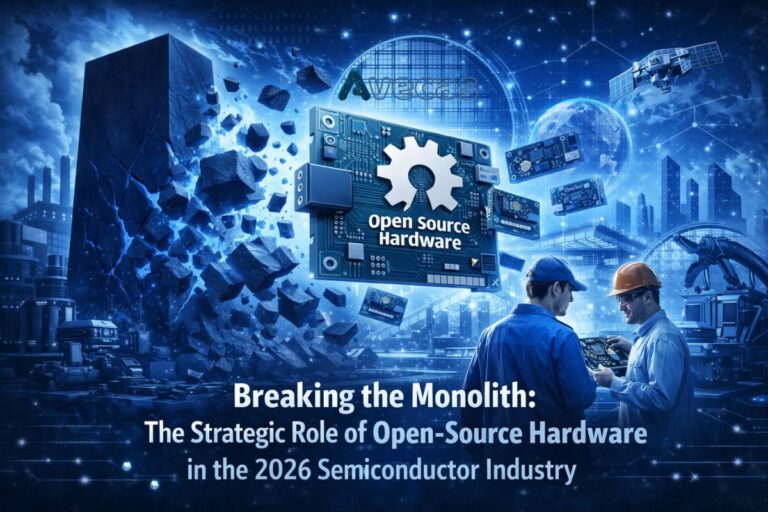
Breaking the Monolith: The Strategic Role of Open-Source Hardware in the 2026 Semiconductor Industry
For the better part of four decades, the semiconductor industry operated behind a high wall of proprietary Intellectual Property (IP) and multi-million dollar licensing fees. If you wanted to design a chip, you had to negotiate complex contracts with a handful of dominant architecture providers. However, as we navigate the landscape of 2026, those walls […]
Bridging the Gap: Strategic Cloud Connectivity Planning for IoT Edge Devices in 2026

In the semiconductor landscape of 2026, the concept of a “simple” sensor is a relic of the past. We have transitioned into an era where IoT edge devices are expected to perform complex local analytics, run lightweight machine learning models, and maintain seamless communication with global cloud infrastructures. We see cloud connectivity not as a […]
The Humanoid Hardware Push: Architecting the Next Gen of Physical AI Chips

For the past decade, the semiconductor industry has been locked in a race to optimize “Digital AI”—chips designed to process text, images, and code within the sterile confines of a data center. However, as we move through 2026, the frontier has shifted. We have entered the era of Physical AI, where artificial intelligence must not […]
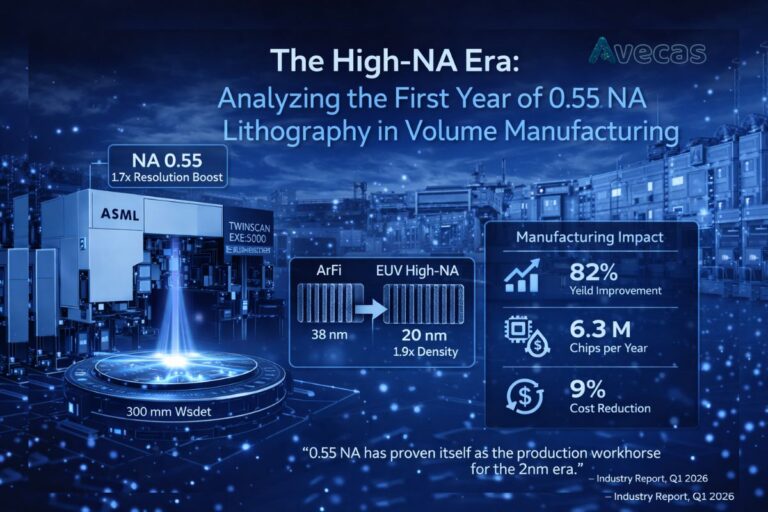
The High-NA Era: Analyzing the First Year of 0.55 NA Lithography in Volume Manufacturing

As of 2026, the semiconductor industry has crossed the threshold into the High-Numerical Aperture (High-NA) era. The deployment of the first production-grade scanners, specifically the ASML Twinscan EXE:5200, has shifted the conversation from laboratory feasibility to high-volume manufacturing (HVM) reality. For the leading-edge foundries currently pushing 2nm and 1.4nm (14A) processes, this technology is no […]
FlexICs for Item-Level Intelligence: The Missing Link in the Global AI and NFC Rollout

For decades, the semiconductor industry has been obsessed with “More Moore,” the relentless pursuit of packing more transistors into smaller, rigid blocks of silicon. While this has given us supercomputers in our pockets, it has also created a significant gap in the Internet of Things (IoT) ecosystem. Traditional silicon chips are brittle, expensive to manufacture […]
Cryogenic CMOS for Quantum Scaling: Designing the Interface Inside the Dilution Refrigerator

In the race to build a fault-tolerant quantum computer, the industry has moved beyond the era of single-qubit experiments. We are now designing systems with hundreds, and soon thousands, of qubits. However, a physical barrier has emerged that threatens to stall this progress: the “wiring crisis.” In a traditional quantum setup, every qubit is controlled […]
Software-Defined Hardware: How 2026 SoCs Adapt to AI Evolution Post-Tape-Out

In the traditional semiconductor lifecycle, the “tape-out” was a point of no return. Once the design was sent to the foundry and the masks were created, the hardware’s logic was frozen in silicon. This rigidity worked for decades when software evolved at a predictable pace. However, in the current landscape of 2026, the artificial intelligence […]
The Vertical Revolution: Why Backside Power Delivery is the Defining Shift for 2nm Silicon
For more than half a century, the architectural blueprint of the integrated circuit followed a singular, logical path. Transistors were built on the silicon substrate, and then layers of metal wiring were built on top of them to handle both data signals and power delivery. This “frontside” approach served the industry well until we reached […]
The Rise of LAMs on Silicon: Moving Beyond Thinking to Doing with VLA Models
For the past several years, the semiconductor industry has been locked in a race to optimize for Large Language Models (LLMs). We built specialized accelerators designed to predict the next word in a sentence, focusing on massive memory bandwidth and high-throughput matrix multiplication. However, as we move through 2026, a new frontier has emerged that […]
The Power Transition: How GaN and SiC are Driving the 2026 EV Surge and Grid Modernization

For decades, the semiconductor industry was synonymous with silicon. It was the reliable, abundant material that powered everything from the first microprocessors to the modern cloud. However, as we move through 2026, the physical limitations of traditional silicon have become a significant bottleneck for the two most critical transitions of our time: the mass electrification […]