Technical starting point
Clock domains, memories, power states and ATE limits.

DFT ARCHITECTURE
Plan test modes and access before scan insertion.
Discuss your requirements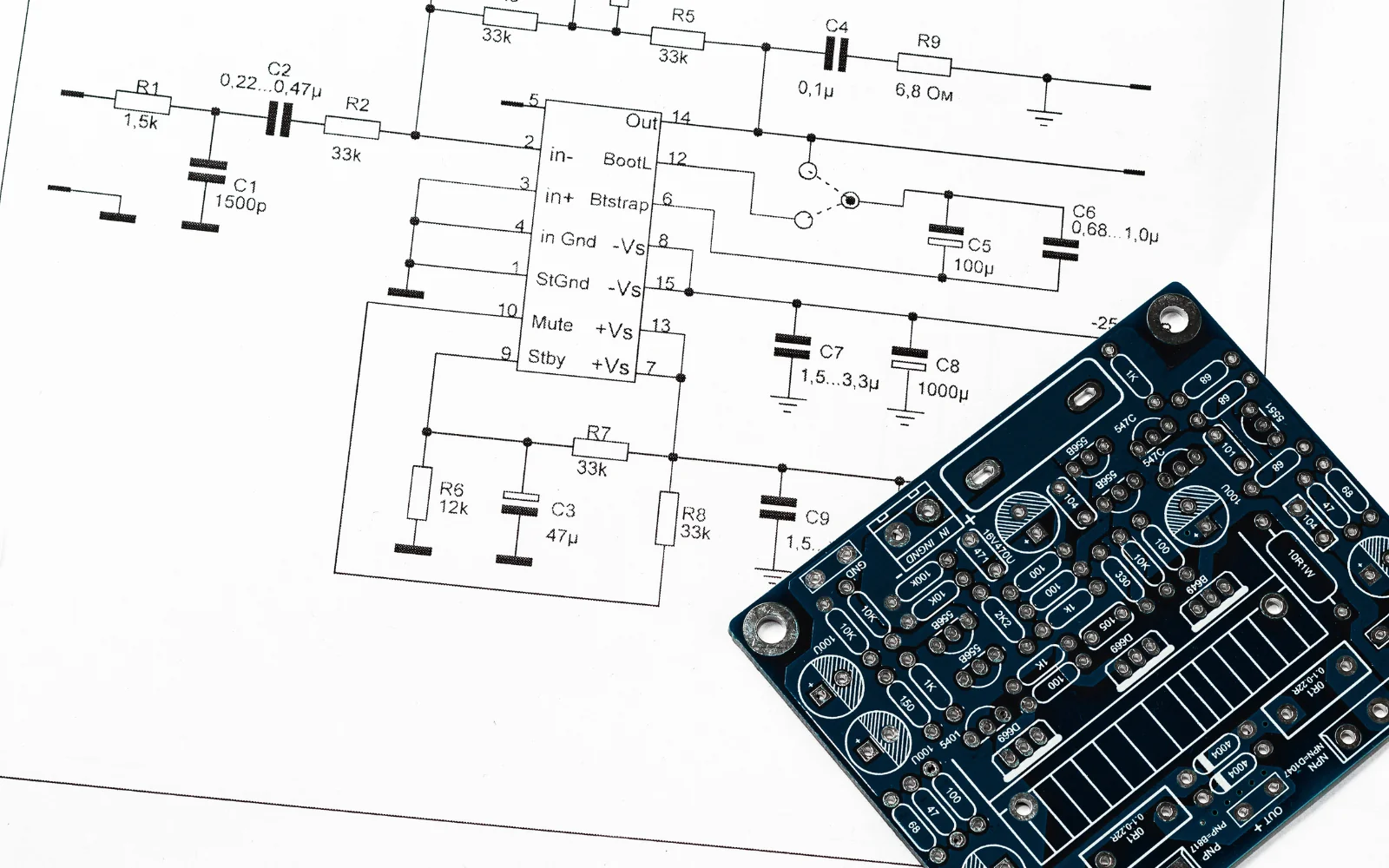
Representative photograph · Printed circuit board alongside its circuit schematic.
THE ENGINEERING SCOPE
Clock domains, memories, power states and ATE limits.
Testability gaps, mode isolation and shift/capture budgets.
DFT specification, access diagrams and implementation constraints.
CLIENT GUIDE
Use these technical checkpoints to make the first project review productive.
HOW WE WORK
The initial review establishes the baseline using clock domains, memories, power states and ATE limits. Record gaps and dependencies before implementation.
Carry out the agreed work against the reviewed baseline. For dft architecture, keep the interfaces and configuration used by this stage visible to the receiving team.
Retain the intermediate artifacts and review testability gaps, mode isolation and shift/capture budgets. Investigate failures before using these results as an input to the next stage.
Package DFT specification, access diagrams and implementation constraints. Review unresolved findings against the agreed acceptance criteria and assign ownership for follow-up.
PROJECT DECISIONS
Use these gates to agree readiness, review evidence and responsibility at each stage.
Are the starting inputs complete enough to proceed?
Clock domains, memories, power states and ATE limits.
Record input revisions, missing material and who can resolve each dependency.
Has the work addressed the agreed technical objective?
Plan test modes and access before scan insertion.
Keep the intermediate artifacts with review comments and the decisions that changed the design.
Can the result be reproduced and interpreted?
Testability gaps, mode isolation and shift/capture budgets.
Capture the configuration, expected result, observed result and unresolved findings.
Can the receiving team use the delivery package?
DFT specification, access diagrams and implementation constraints.
Review build or execution instructions, known limitations and ownership of follow-up actions.
INPUTS & OUTPUTS
The final statement of work defines the scope and acceptance criteria.
TECHNICAL DECISIONS
Plan test modes and access before scan insertion.
The work starts from clock domains, memories, power states and ATE limits. The team should identify the authoritative revision of each input and record any assumptions needed to proceed. This prevents a later result from being interpreted against a different specification or configuration.
Architecture decisions determine which faults can be observed and controlled downstream.
The review centres on testability gaps, mode isolation and shift/capture budgets. Each finding should identify the input revision, observed behaviour and supporting evidence. Distinguish a confirmed defect from a configuration issue, an unsupported case or an open engineering question before deciding how to resolve it.
The practical sequence is: map test targets; allocate access and control; plan compression and memory test; review integration. Intermediate reviews allow the client to resolve decisions while changes are still manageable. If an input changes, identify the affected activities and repeat the checks that depend on it.
The expected package comprises DFT specification, access diagrams and implementation constraints. Acceptance criteria should specify what the receiving team needs to reproduce, inspect or integrate these artifacts. Include known limitations and outstanding actions in that package, rather than assuming that delivery of a file implies acceptance.
Test logic has to work within the design’s clock, reset and power architecture. Identify which test modes are legal, how they are entered, which domains remain powered and how functional interfaces are isolated. Review the sources of unknown values and the controls needed to make scan shifting and capture deterministic. A test mode that works only under an undocumented assumption is difficult to transfer to another team.
Coverage discussions should name the fault model, denominator and classification of excluded or untestable faults. Pattern generation can expose design-rule issues, uncontrollable signals or protocol assumptions that require architecture changes. Separate those causes from faults that simply need better stimulus or additional ATPG effort. Preserve enough detail for a reviewer to understand why a target was or was not met.
Pattern count, tester memory, shift frequency and capture activity affect whether a pattern set is practical. Agree these constraints early and revisit them after integration. The handoff should connect patterns to the exact netlist, test protocol and configuration used to generate them. Simulation results, mode-entry checks and known restrictions should travel with the pattern package so downstream teams can reproduce the intended test conditions.
A memory output that is uncontrolled during scan capture can contaminate a compressed response. Review whether the correct solution is mode control, isolation, a justified mask or an architecture change. Check the resulting fault coverage and power implications rather than masking broadly to obtain a clean simulation. The example illustrates a diagnostic approach, not a universal test insertion recipe.
BEFORE WE BEGIN
A clear conversation is the start of a strong engineering relationship.
The starting review needs clock domains, memories, power states and ATE limits. Share the current revision and known limitations so the scope reflects the actual design state.
The statement of work can define DFT specification, access diagrams and implementation constraints. The final package should include review results and any open actions.
Architecture decisions determine which faults can be observed and controlled downstream.
The first work package can be a review of the available inputs and the engineering questions that must be resolved. Agree its boundaries, access requirements and expected findings before committing to a larger implementation. A review should leave an actionable list of decisions, dependencies and next steps.
Tie each finding to the relevant revision and supporting evidence. A change should identify the affected interfaces, activities and checks. Confirm its effect on scope and delivery with the responsible owner. At handoff, distinguish closed findings, accepted limitations and open work so that a file transfer is not mistaken for technical acceptance.
PUT THE WORKFLOW IN CONTEXT
Practical reading to help prepare your project discussion. Studies are illustrative; they do not report client results.
Planning scan test without losing the system context ↗YOUR NEXT CHAPTER STARTS HERE
Bring us your engineering challenge.
Let’s define the path from idea to implementation.