

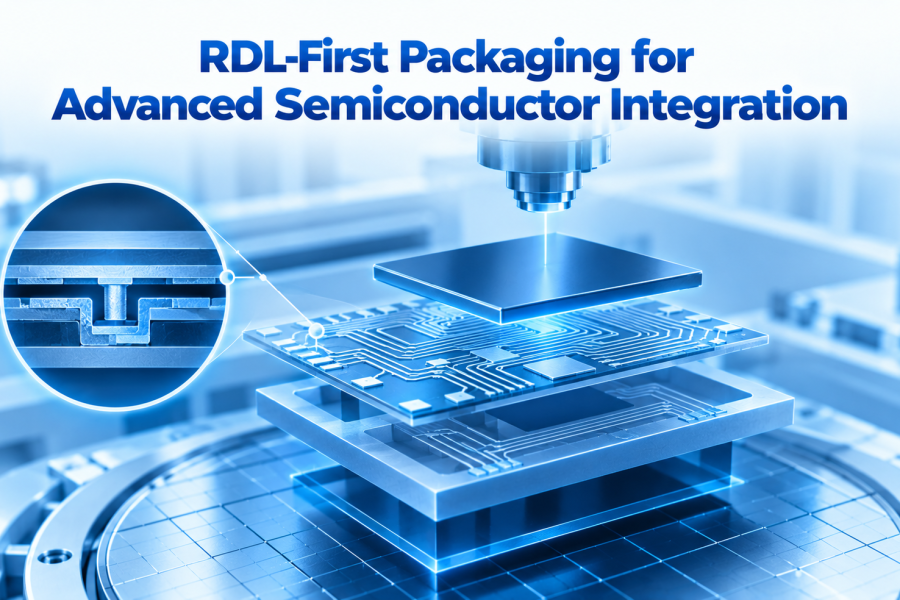
As semiconductor architectures become increasingly complex, traditional packaging approaches are being challenged by rising I/O density, chiplet integration, package size requirements, and manufacturing costs. Advanced packaging technologies are evolving to provide shorter interconnects, higher bandwidth, and greater integration within increasingly compact form factors.
One approach gaining significant attention is RDL-First Packaging. By fabricating the redistribution layer (RDL) before semiconductor dies are integrated into the package, this architecture can enable fine-pitch interconnects and flexible package designs for advanced semiconductor applications.
What Is RDL-First Packaging?
RDL-First (Redistribution Layer-First) Packaging is an advanced semiconductor packaging approach in which the redistribution layers are fabricated before the semiconductor dies are assembled or embedded.
In a conventional packaging flow, the die is typically placed first, followed by processes that create redistribution structures around or above it. In an RDL-first approach, the package’s fine-pitch interconnect structure is created on a temporary carrier first.
A simplified flow can be represented as:
Carrier Preparation → RDL Formation → Die Placement → Encapsulation → Interconnect Formation → Singulation
The RDL provides electrical routing between the die’s connection points and the package-level external connections.
This architecture is particularly relevant to fan-out wafer-level packaging (FOWLP), fan-out panel-level packaging (FOPLP), chiplet integration, and heterogeneous semiconductor packaging.
Why RDL-First Packaging Matters
Modern semiconductor packages increasingly require high-density connections between multiple dies and external systems. As die-to-package I/O counts increase, conventional packaging approaches can face limitations in routing density and process scalability.
RDL-first packaging offers several potential advantages.
Fine-Pitch Interconnect Capability
Because the RDL is fabricated using semiconductor-style thin-film processing before die placement, manufacturers can create highly controlled routing structures.
Greater Design Flexibility
The RDL can be designed to accommodate different die sizes, I/O configurations, and package architectures.
Improved Package Integration
Multiple dies can potentially be connected through a common redistribution structure, making the approach attractive for multi-die and chiplet-based packages.
Reduced Package Footprint
Fan-out architectures can extend electrical connections beyond the die edge, enabling more I/O without necessarily increasing the die size.
Manufacturing Scalability
RDL-first processing can be adapted to wafer-level or panel-level manufacturing approaches, providing opportunities for high-volume advanced packaging.
Key Advantages of RDL-First Packaging
RDL-first packaging is attractive because it combines high-density thin-film interconnect technology with flexible multi-die integration.
High-Density Routing
Fine-pitch RDL structures can provide dense electrical pathways between semiconductor dies and external package connections.
Chiplet Integration
As chiplet architectures become more common, RDL structures can serve as an important interconnect layer for connecting multiple functional dies within a package.
Heterogeneous Integration
Different types of dies—including logic, memory, analog, RF, and other specialized components—can potentially be integrated within a common package architecture.
Shorter Electrical Paths
Advanced RDL designs can provide relatively short connections between integrated dies, supporting high-bandwidth and performance-sensitive applications.
Package-Level Scalability
When combined with fan-out and panel-level processing, RDL-first approaches can offer opportunities to increase package manufacturing efficiency.
Applications and Future of RDL-First Packaging
The demand for higher computing performance and greater integration is driving continued development of advanced packaging technologies.
RDL-first packaging has potential applications in:
- Chiplet-based processors
- AI and machine-learning accelerators
- High-performance computing (HPC)
- Mobile and consumer electronics
- Networking and communications devices
- Heterogeneous integration
- Advanced memory and logic packages
Its importance is expected to grow as semiconductor designers increasingly move beyond single-die scaling toward system-level integration.
Future developments are likely to focus on finer RDL pitches, improved materials, better warpage control, larger processing formats, enhanced inspection, and integration with panel-level packaging and other advanced packaging technologies.
Conclusion
RDL-First Packaging represents an important approach to advanced semiconductor integration, placing high-density redistribution structures at the foundation of the package before die assembly.
By enabling fine-pitch routing, flexible die integration, fan-out architectures, and potential chiplet connectivity, RDL-first technology can help address the growing interconnect demands of modern semiconductor systems.
As the industry advances toward AI processors, chiplets, heterogeneous integration, and high-performance computing, innovations in redistribution-layer technology will become increasingly important.
For semiconductor engineers and packaging professionals, understanding RDL-first packaging, its process flow, advantages, challenges, and applications provides valuable insight into the future of advanced semiconductor packaging.