

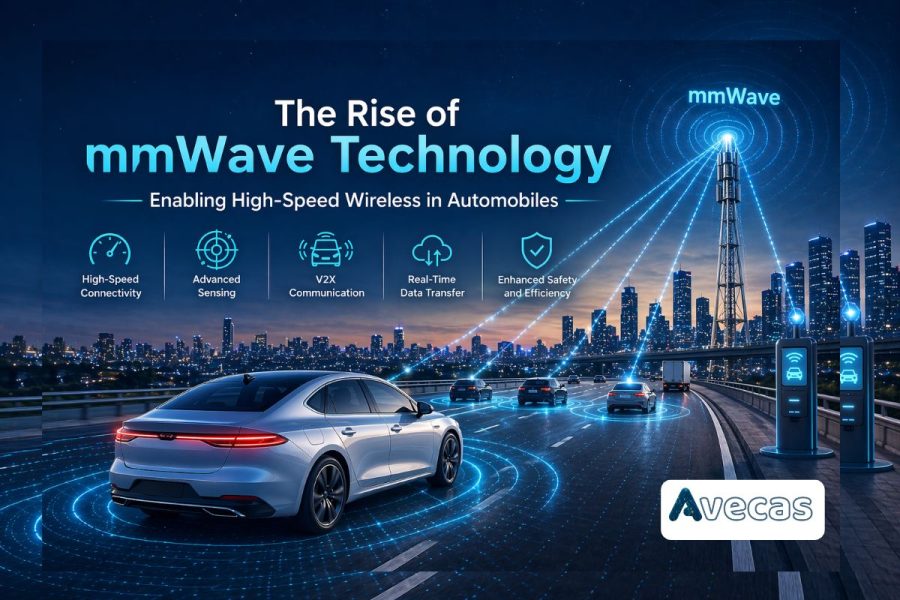
The automotive industry is going through a major transformation driven by connectivity, automation, and intelligent systems. One of the key technologies accelerating this shift is mmWave technology. As vehicles become more connected and data driven, the need for faster and more reliable wireless communication is growing rapidly. This is where mmWave technology is making a strong impact.
What is mmWave Technology
Millimeter wave or mmWave refers to a range of radio frequencies between 30 GHz and 300 GHz. These high frequency bands enable ultra fast data transmission with low latency. While mmWave is widely associated with 5G networks, its applications in the automotive sector are becoming equally important.
Unlike traditional communication systems, mmWave supports high bandwidth and can handle massive data loads. This makes it ideal for modern vehicles that rely on real time data exchange for safety, navigation, and autonomous operations.
Why mmWave is Important for Automobiles
Modern vehicles are no longer just mechanical machines. They are complex electronic systems equipped with sensors, cameras, radar, and communication modules. These components generate and process large amounts of data every second.
mmWave technology helps in managing this data efficiently by offering
- Ultra high speed data transfer
- Low latency communication
- High precision sensing capabilities
- Reliable connectivity even in dense environments
This combination is essential for advanced driver assistance systems and autonomous driving technologies.
Applications of mmWave in Automotive Industry
Advanced Driver Assistance Systems
mmWave radar is widely used in ADAS features such as adaptive cruise control, collision avoidance, and blind spot detection. It provides accurate distance and speed measurement, even in poor weather conditions like fog, rain, or dust.
Autonomous Driving
Self driving vehicles require continuous communication between sensors and control systems. mmWave enables real time data processing and communication, helping vehicles make faster and safer decisions on the road.
Vehicle to Everything Communication
Vehicle to Everything or V2X communication allows cars to communicate with other vehicles, infrastructure, and even pedestrians. mmWave enhances V2X by enabling high speed data exchange, which improves traffic management and road safety.
In Vehicle Infotainment
Modern consumers expect seamless connectivity inside their vehicles. mmWave supports high speed internet, streaming, and real time navigation updates, enhancing the overall driving experience.
Industry Trends and Adoption
Automotive manufacturers and semiconductor companies are heavily investing in mmWave technology. With the rollout of 5G networks, integration of mmWave in vehicles is becoming more practical and scalable.
Leading companies are developing mmWave chipsets and radar solutions tailored for automotive applications. These innovations are helping reduce cost, improve performance, and accelerate adoption across different vehicle segments.
In addition, regulatory support and standardization are also playing a key role in driving the adoption of mmWave technology in the automotive ecosystem.
Challenges to Overcome
Despite its advantages, mmWave technology comes with certain challenges
- Limited range compared to lower frequency signals
- Signal blockage due to obstacles
- Higher implementation cost
- Need for advanced antenna design
However, ongoing research and development are addressing these challenges. Technologies like beamforming and advanced signal processing are improving the reliability and performance of mmWave systems.
The Future of mmWave in Automobiles
The future of automotive technology is closely linked with connectivity and automation. mmWave is expected to play a central role in enabling next generation vehicles that are safer, smarter, and more efficient.
As 5G infrastructure expands and technology costs decrease, mmWave will become a standard feature in connected and autonomous vehicles. It will support innovations such as smart highways, real time traffic management, and enhanced vehicle intelligence.
Conclusion
mmWave technology is redefining how vehicles communicate and operate in a connected world. From improving safety systems to enabling autonomous driving and enhancing user experience, its impact on the automotive industry is significant.
For industry professionals and technology enthusiasts, understanding mmWave is essential to stay ahead in the rapidly evolving automotive landscape. As adoption continues to grow, mmWave will be a key driver of innovation in future mobility.