

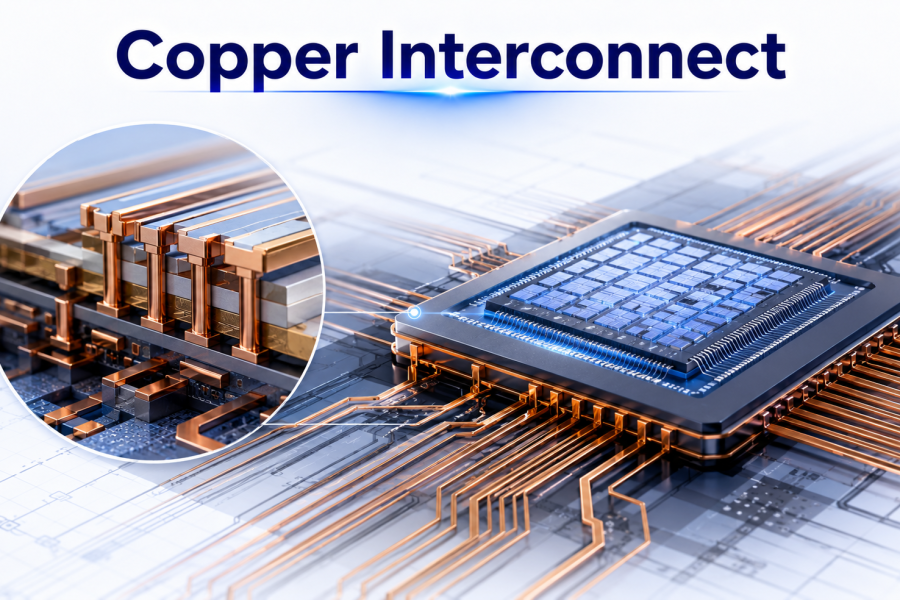
Modern semiconductor chips contain billions of transistors working together to execute complex computing tasks. While transistor scaling has dramatically increased processing power, the performance of a chip also depends on how efficiently these transistors communicate with one another. As feature sizes continue to shrink, interconnect materials play an increasingly critical role in determining signal speed, power consumption, and overall device reliability.
Copper Interconnect Technology revolutionized semiconductor manufacturing by replacing traditional aluminum wiring with copper, a material that offers significantly lower electrical resistance and superior current-carrying capability. Today, copper interconnects are a fundamental component of advanced integrated circuits, enabling high-speed data transmission and improved energy efficiency across processors, memory devices, and system-on-chip (SoC) designs.
What is Copper Interconnect?
Copper Interconnect is the network of microscopic copper wiring that electrically connects transistors and other circuit elements within an integrated circuit (IC). These interconnections are fabricated during the Back-End-of-Line (BEOL) stage of semiconductor manufacturing after the transistor structures have been completed.
Copper is used because of its excellent electrical conductivity and lower resistivity compared to aluminum. This allows electrical signals to travel faster while reducing power loss and heat generation.
Why is Copper Interconnect Important?
As integrated circuits become increasingly complex, efficient signal transmission is essential for maintaining performance and reducing energy consumption.
Copper Interconnect Technology offers several important advantages:
- Lower electrical resistance
- Faster signal propagation
- Reduced RC delay
- Lower power consumption
- Higher current-carrying capacity
- Improved chip performance
- Better thermal conductivity
- Increased device reliability
- Supports advanced semiconductor scaling
- Enables high-density integrated circuits
Technology Behind Copper Interconnect
Manufacturing copper interconnects requires highly advanced fabrication processes that ensure precise patterning and reliable electrical performance.
Key technologies include:
- Dual Damascene Process: Simultaneously forms copper metal lines and vias by etching trenches into the dielectric and filling them with copper.
- Electrochemical Copper Plating: Deposits copper uniformly into nanoscale trenches and vias with excellent filling characteristics.
- Chemical Mechanical Planarization (CMP): Removes excess copper and creates an ultra-flat wafer surface for subsequent metal layers.
- Barrier and Liner Deposition: Thin layers of tantalum or tantalum nitride prevent copper diffusion and improve adhesion.
- Low-k Dielectric Materials: Reduce parasitic capacitance between adjacent copper interconnects, improving signal speed.
- Advanced BEOL Integration: Multiple stacked metal layers are fabricated with precise alignment, enabling billions of reliable electrical connections within a single chip.
Applications
Copper Interconnect Technology is used across nearly every advanced semiconductor product, including:
- Central Processing Units (CPUs)
- Graphics Processing Units (GPUs)
- Artificial Intelligence (AI) accelerators
- High-Performance Computing (HPC) processors
- DRAM and High-Bandwidth Memory (HBM)
- Mobile System-on-Chip (SoC) devices
- Networking and communication chips
- Automotive semiconductor electronics
- Data center processors
- Advanced chiplet-based architectures
Conclusion
Copper Interconnect Technology has become one of the most important innovations in semiconductor manufacturing by enabling faster, more reliable communication between billions of transistors. Its low electrical resistance, excellent conductivity, and compatibility with advanced fabrication processes have significantly improved chip performance while reducing power consumption.
As the semiconductor industry continues developing more powerful processors, advanced memory technologies, AI hardware, and next-generation computing platforms, Copper Interconnects will remain an essential element of integrated circuit design. Combined with innovations in low-k dielectrics, advanced BEOL processing, and 3D integration, copper will continue to serve as the backbone of modern semiconductor communication.