

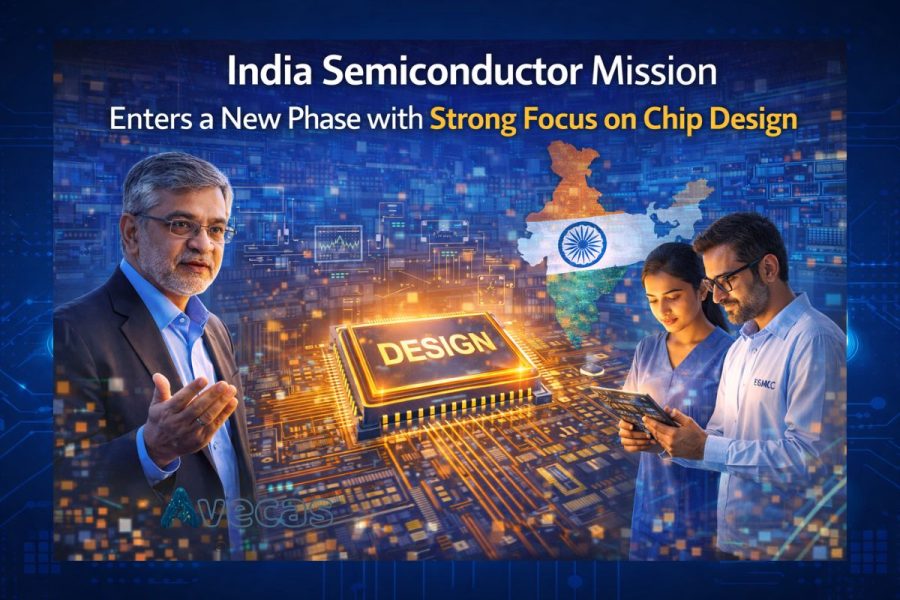
India’s semiconductor journey is entering a decisive new chapter as the government prepares to realign its strategy toward advanced chip design and innovation. Union Minister for Electronics and Information Technology Ashwini Vaishnaw recently highlighted that the next phase of the India Semiconductor Mission will place design capabilities at the center of the country’s technology roadmap.
Speaking at a semiconductor industry event in Bengaluru, the minister stated that India is moving beyond its traditional role as a support and services hub. The focus is now on creating high value semiconductor designs that can compete on a global stage. According to him, India’s strength lies in its engineering talent and system level understanding, which makes chip design a natural area of leadership.
Design Becomes the Core of India’s Semiconductor Strategy
Under the upcoming phase of the India Semiconductor Mission, chip design will be treated as a strategic priority. This includes architecture development, verification, validation, and creation of intellectual property that can power next generation applications. The government aims to support startups, design houses, and global technology companies that are building advanced silicon solutions from India.
The minister emphasized that India already plays a significant role in global chip design workflows. With focused policy support, this contribution is expected to grow into complete ownership of complex semiconductor designs, including those for artificial intelligence, automotive electronics, high performance computing, and advanced communication systems.
Bengaluru Strengthens Its Position as a Design Hub
Bengaluru continues to emerge as the heart of India’s semiconductor design ecosystem. The city hosts major design centers of global technology companies and a growing number of domestic startups working on cutting edge silicon products. The recent unveiling of advanced chip designs developed in India reflects the maturity of the local ecosystem and its ability to deliver world class innovation.
This progress also signals confidence from global players in India’s engineering talent and design capabilities. As more companies expand their design operations, Bengaluru is expected to play a key role in shaping India’s semiconductor future.
Building a Complete and Sustainable Ecosystem
While fabrication and assembly remain important, the government’s renewed approach recognizes that design is where maximum value is created in the semiconductor value chain. The mission will also focus on strengthening supporting areas such as electronic design automation tools, skilled workforce development, and collaboration between industry and academic institutions.
By encouraging end to end innovation, the government aims to ensure that India not only designs chips but also builds sustainable businesses around them. This approach is expected to attract long term investment and position India as a reliable partner in the global semiconductor supply chain.
What This Means for the Semiconductor Industry
For technology companies, design firms, and VLSI solution providers, this policy direction opens new opportunities. Increased support for design led innovation means greater scope for custom silicon development, advanced verification, and system level integration. It also creates a strong environment for collaboration between startups, established companies, and research institutions.
India’s semiconductor vision is clearly evolving from participation to leadership. With a strong emphasis on chip design, the country is setting the foundation to become a global innovation hub for next generation silicon technologies.