

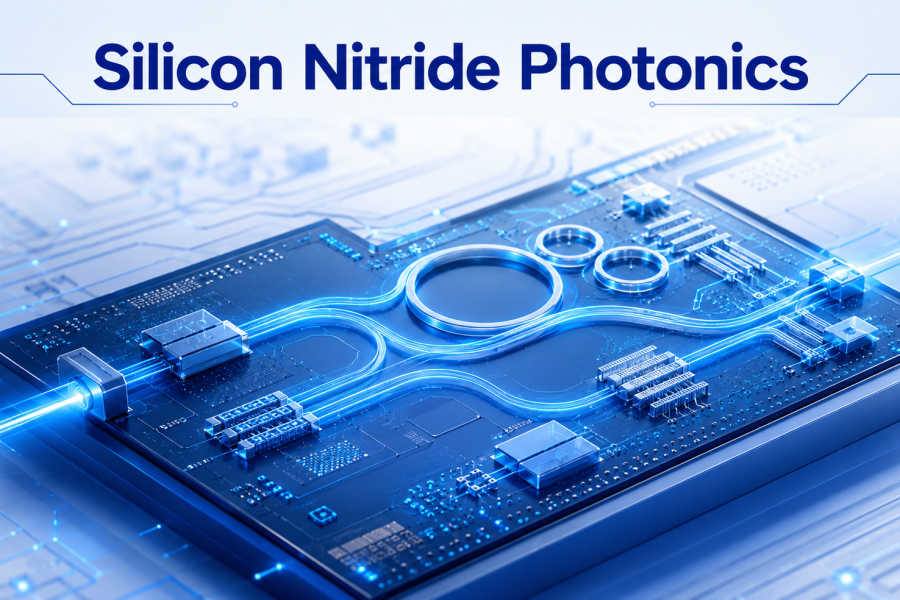
As optical technologies move toward higher performance, lower losses, and greater integration, Silicon Nitride (SiN) photonics has emerged as an important platform for advanced photonic systems. Its combination of low optical loss, broad wavelength transparency, strong nonlinear properties, and compatibility with semiconductor manufacturing makes it attractive for applications ranging from telecommunications to quantum technologies.
What Is Silicon Nitride Photonics?
Silicon Nitride photonics is a photonic integrated circuit technology that uses silicon nitride as the optical waveguide material.
In a photonic integrated circuit, waveguides guide light between components such as:
- Lasers
- Modulators
- Photodetectors
- Resonators
- Splitters and couplers
- Frequency converters
Silicon nitride is particularly valuable because it offers a combination of properties that can be difficult to achieve simultaneously with conventional silicon photonics.
Its relatively low propagation loss and broad optical transparency make it suitable for applications where maintaining optical signals over longer distances or across broad wavelength ranges is important.
Why Is Silicon Nitride Important?
The performance of a photonic platform depends heavily on its material properties. Silicon nitride provides several advantages that make it an attractive complement to silicon photonics.
Low Optical Loss
High-quality SiN waveguides can achieve extremely low propagation losses, making them suitable for applications requiring long optical paths and high-quality resonators.
Broad Transparency
Silicon nitride supports operation across a wide optical spectrum, enabling applications beyond traditional telecom wavelengths.
Strong Nonlinear Performance
SiN can support nonlinear optical processes such as frequency conversion and frequency-comb generation while avoiding some of the limitations associated with other materials.
CMOS Compatibility
SiN photonic structures can be fabricated using processes compatible with established semiconductor manufacturing infrastructure, supporting scalable production.
Thermal and Environmental Stability
SiN-based photonic structures can provide useful stability for precision optical systems where environmental variations need to be controlled.
How Does Silicon Nitride Photonics Work?
At the heart of a SiN photonic circuit are carefully engineered waveguides that confine and guide light.
A typical SiN photonic system may involve several stages:
Light Source → Coupler → SiN Waveguide → Optical Function → Detector
The silicon nitride layer is patterned to create waveguides with controlled dimensions. These waveguides can then be combined with resonators, interferometers, filters, and other optical structures.
One particularly important feature is the ability to fabricate high-Q optical resonators. These structures allow light to circulate for extended periods, making them useful for sensing, filtering, frequency stabilization, and nonlinear photonics.
Applications of Silicon Nitride Photonics
Silicon nitride photonics is finding opportunities across multiple technology sectors.
Telecommunications
Low-loss waveguides and optical filtering capabilities make SiN attractive for advanced communication systems and wavelength-management technologies.
Frequency Combs
SiN microresonators can generate optical frequency combs, which provide many precisely spaced optical frequencies from a single source.
These are important for spectroscopy, communications, metrology, and precision timing.
Quantum Photonics
Low-loss optical circuits are highly valuable for manipulating and routing quantum states of light. SiN is therefore being explored for scalable quantum photonic systems.
LiDAR and Optical Sensing
SiN can support compact optical circuits used in sensing and ranging systems, including emerging integrated LiDAR architectures.
Astronomy and Precision Metrology
The low-loss and high-Q characteristics of SiN photonics make it useful for applications requiring extremely precise optical frequency control and measurement.
Conclusion
Silicon Nitride Photonics is becoming a key platform for precision optical integration. Its combination of low optical loss, broad transparency, nonlinear capabilities, high-Q resonators, and semiconductor-compatible manufacturing makes it particularly valuable for applications that demand high optical performance.
From optical communications and frequency combs to quantum photonics, LiDAR, sensing, and precision metrology, SiN is expanding the capabilities of integrated photonics.
As heterogeneous integration and advanced semiconductor packaging continue to evolve, silicon nitride could become an increasingly important building block for next-generation photonic systems.