RTL & architecture
Turn system requirements into clear microarchitecture, synthesizable RTL, and an integration plan.

ENGINEERING CAPABILITIES
Explore IC design and embedded engineering services across architecture, verification, implementation, and system integration.
Discuss your requirements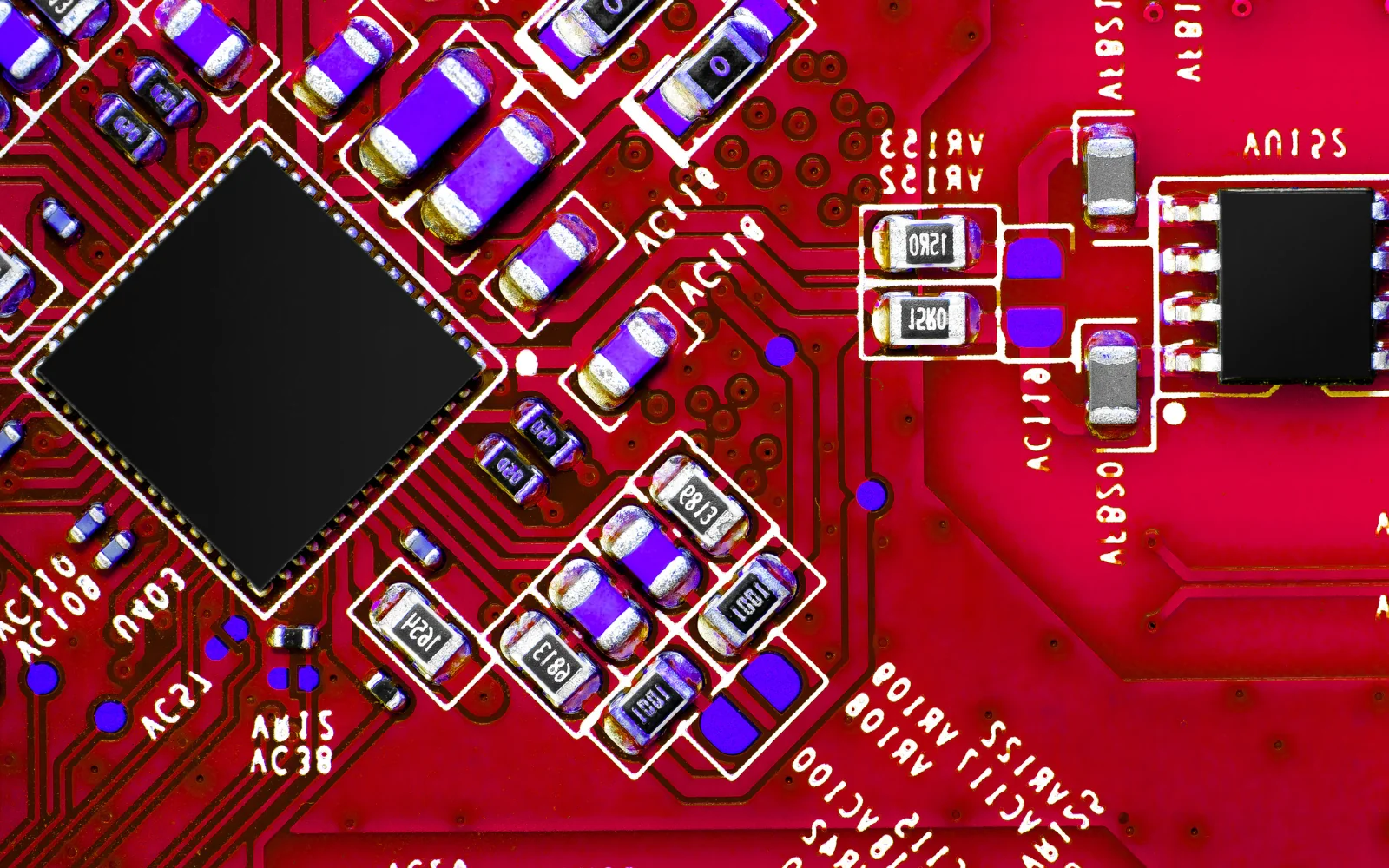
Representative photograph · Surface-mounted integrated circuits on a red circuit board.
THE ENGINEERING SCOPE
Turn system requirements into clear microarchitecture, synthesizable RTL, and an integration plan.
Build confidence with verification planning, simulation, coverage analysis, and formal methods.
Connect implementation decisions to timing, power, area, and physical signoff requirements.
Plan test architecture, scan integration, ATPG, and the handoff to production test.
Support analog layout, integration, and verification across the agreed process and design rules.
Bring hardware and software together through prototyping, firmware, and system validation.
HOW WE WORK
Review the design challenge, available inputs, and target outcomes.
Agree the work package, ownership, interfaces, and delivery evidence.
Execute with technical reviews and traceable issue resolution.
Review the agreed sources, reports, and integration collateral.
PROJECT DECISIONS
Use these gates to agree readiness, review evidence and responsibility at each stage.
What should be clear before progressing?
Review the design challenge, available inputs, and target outcomes.
Agree the owner, supporting artifacts and the decision needed to move to the next stage.
What should be clear before progressing?
Agree the work package, ownership, interfaces, and delivery evidence.
Agree the owner, supporting artifacts and the decision needed to move to the next stage.
What should be clear before progressing?
Execute with technical reviews and traceable issue resolution.
Agree the owner, supporting artifacts and the decision needed to move to the next stage.
What should be clear before progressing?
Review the agreed sources, reports, and integration collateral.
Agree the owner, supporting artifacts and the decision needed to move to the next stage.
ENGINEERING GUIDE
Use the directory to identify the engineering decision you need help with. An architecture question, an implementation task and a failing-system investigation need different inputs and different acceptance criteria. Start with the most specific discipline, then identify adjacent work that must be coordinated.
For a new chip or system, agree interface ownership before splitting the work across teams. For an existing design, provide the current baseline and the evidence behind the problem statement. Include known limitations and the environment in which the issue occurs. This helps distinguish a focused review from a larger redevelopment effort.
A useful first conversation ends with a proposed scope, prerequisites, deliverables and review points. The service pages describe typical engineering activities; the actual statement of work confirms available expertise, tooling, schedule and responsibilities. Contact Avecas with a short non-confidential summary before sharing protected design files.
A useful engagement starts with a bounded problem and a named owner for the result. Separate technical scope, staffing assumptions and commercial arrangements. State which team owns architecture, implementation, integration and final acceptance. Identify external dependencies, including tools, licensed data, hardware availability and decisions that the client must provide before work can proceed.
Milestones should represent reviewable outputs. A schedule can show when an architecture review, implementation baseline, validation package or integration handoff is expected, together with the prerequisites for each. Track open decisions and their effect on downstream work. When the scope changes, revise the affected estimates and acceptance criteria rather than treating the change as an informal addition.
Plan for continuity after delivery. The receiving team should know which sources and reports are authoritative, how to reproduce key results and where limitations are recorded. Discuss the support period, issue triage and responsibility for integration separately from the initial delivery. Current staffing availability, location, lead times and commercial terms are confirmed for the actual engagement.
A useful brief starts with the product decision, rather than a list of tools. Describe the intended application, the present design state and the next milestone. Separate constraints that are fixed from preferences that can change. For example, an existing package or board connector may be fixed while buffer depth, software scheduling or implementation hierarchy remains open. Give each constraint an owner so that a review can resolve tradeoffs without relying on assumptions.
For silicon work, identify the architecture baseline, interfaces, clocking, reset sequence, power intent and available technology collateral. Explain whether the engagement begins with a specification, RTL, a synthesized netlist, a placed design or fabricated devices. These starting points require different evidence. A verification team needs expected behaviour and an observable test interface; a physical implementation team also needs usable constraints and consistent library views. A test team needs the intended test modes, package connections and an agreed method for interpreting results.
For embedded work, include the processor or controller, board revision, boot path, operating environment, peripheral interfaces and available diagnostic access. State which failure modes matter to the application. A system that boots once on a development bench may still need recovery, update, endurance, timing and resource checks before release. Describe representative workloads and explain how the team will obtain logs when a failure occurs outside the laboratory.
Choose the engagement around ownership. A focused assessment can produce a finding register and a recommended next step. An implementation package requires agreed inputs, delivery artifacts and review gates. A broader turnkey programme needs explicit coordination between architecture, verification, implementation and downstream partners. Responsibilities for procurement, third-party IP, manufacturing, certification and final product acceptance should be recorded separately rather than assumed to be included.
Plan reviews around usable evidence. At the first gate, confirm that the inputs are complete enough to begin. During execution, review changes against the baseline and investigate unexpected results. At handoff, check that another engineer can identify the correct revision, reproduce the agreed checks and understand unresolved items. Deliverables should include configuration details and limitations alongside the output files. The receiving team should know who owns each remaining action.
Start the conversation with a short non-confidential summary through the contact page. Include the discipline, starting point, expected deliverable and target milestone. Avoid sending proprietary RTL, PDK files, customer data or credentials through a public form. Once the appropriate confidentiality and access arrangements are in place, the project team can agree a controlled method for sharing technical material and refining the estimate.
BEFORE WE BEGIN
A clear conversation is the start of a strong engineering relationship.
Yes. A focused engagement can cover a particular design, verification, implementation, or integration requirement.
The target process, IP, EDA tools, licenses, and engineering requirements are reviewed for each engagement before scope and schedule are committed.
PUT THE WORKFLOW IN CONTEXT
Practical reading to help prepare your project discussion. Studies are illustrative; they do not report client results.
What belongs in a turnkey IC-design project brief ↗ENGINEERING DIRECTORY
Each guide explains the starting inputs, engineering sequence, checks and handoff for a defined work package.
102 engineering guides
Integrate sensing and compute pipelines around defined assistance functions.
Review interconnect and package integration for the intended assembly technology.
Check interactions between continuous-time circuits and digital control.
Develop circuits against gain, bandwidth, noise, power and operating-range requirements.
Translate circuit intent into layout while controlling matching, parasitics, isolation and physical-rule compliance.
Integrate model behaviour into a measurable product workflow.
Evaluate package interfaces, interconnect requirements and thermal/mechanical constraints before assembly release.
Integrate instrument resources, pin electronics and pattern execution.
Generate and debug patterns against agreed fault models.
Coordinate embedded software and hardware within the vehicle-system boundary.
Configure automotive software interfaces and platform services.
Explore Avecas VLSI Flow: design configuration, stage orchestration, generated scripts, reports and engineering evidence.
Implement monitoring and control interfaces for a defined battery system.
Enable controlled board and device test access through a documented test interface.
Make engineering environments reproducible and maintainable.
Maintain repeatable flows and reference checks across engineering teams.
Compare complete engagement costs rather than headline hourly rates.
Organise engineering evidence for the product's applicable assessment path.
Develop an integration-ready block around explicit interfaces, configurability, verification and implementation assumptions.
Plan and implement test access so manufacturing defects can be targeted without compromising functional operation.
Make recurring engineering decisions and checks explicit in a reusable flow.
Build evidence that the design implements its specification across normal operation, boundary cases and error conditions.
Connect hardware capabilities to an operating-system interface with controlled resource and lifecycle management.
Evaluate device characteristics against the intended operating envelope.
Plan test modes and access before scan insertion.
Check inserted test structures and protocols before pattern release.
Develop signal-processing methods around measurable signal and compute requirements.
Map compute kernels to the right execution resources.
Apply controlled design changes while checking their functional and implementation impact.
Implement control-unit behaviour with defined diagnostics and communication.
Turn a manual sequence into a controlled, inspectable engineering workflow.
Connect tools through validated inputs, outputs and execution environments.
Investigate tool and environment issues using reproducible engineering cases.
Deploy inference where connectivity, energy and latency constrain the system.
Support edge-AI implementation choices across model constraints, acceleration targets, memory limits, data movement, and deployment validation.
Design electronic platforms around functional interfaces, component constraints and a measurable bring-up plan.
Fit model inference into a constrained software platform.
Provide reusable services with clear resource and error-handling contracts.
Build a software stack that respects hardware constraints and lifecycle needs.
Connect board-level hardware, firmware and application behaviour into a testable product architecture.
Combine component tests with hardware-backed integration checks.
Structure specialist support around a bounded technical problem and clear responsibilities.
Build maintainable applications and automation around the real engineering workflow, access model and data lifecycle.
Isolate failure mechanisms through a staged investigation.
Implement dependable device behaviour from startup through normal operation, updates and fault recovery.
Use properties and exhaustive reasoning within a defined model and assumptions.
Partition functions across programmable logic and processors with explicit data movement and timing contracts.
Partition logic, memory and interfaces to meet streaming and control goals.
Translate signal-processing operations into timed hardware pipelines.
Bring a design onto a prototype board with observable interfaces.
Use programmable hardware to explore system behaviour and software integration.
Support traceability and safety-related work products within an agreed development process.
Measure board behaviour against electrical and functional requirements.
Check the interface contract between software and hardware before release.
Explore IC design and embedded engineering services across architecture, verification, implementation, and system integration.
Package custom logic for a defined integration and reuse model.
Support library views and technology collateral used by implementation and verification teams.
Organise and validate design libraries against agreed integration requirements.
Map RTL into implementation cells under defined timing and area constraints.
Coordinate test operation with power domains and isolation.
Implement and verify power-control intent across the design flow.
Coordinate power states, hardware architecture and software policy.
Connect design outputs with package, assembly and test requirements through an agreed partner and handoff model.
Add self-test mechanisms suited to the memories and logic under test.
Bring design, verification, implementation, and delivery into a clearly scoped engagement. Agree the milestones, interfaces, and acceptance evidence before execution begins.
Evaluate an external work package through scope clarity, evidence and integration ownership.
Translate schematic connectivity into a manufacturable board layout.
Check technology collateral for consistency within the supported design environment.
Convert a constrained netlist into a placed and routed implementation while balancing timing, power, area and routability.
Check layout connectivity and geometry against the selected rule decks.
Measure real-device behaviour against functional, performance and power requirements.
Evaluate energy delivery and heat removal across operating modes.
Plan on-chip power connectivity around current demand and physical constraints.
Connect process-related data and design requirements through documented analysis.
Bridge design test intent and tester execution.
Coordinate technical dependencies and acceptance decisions across work packages and delivery teams.
Plan stress evaluation against defined product requirements.
Explore research collaboration, custom IP development, and the path from an engineering idea to a documented result.
Translate interface and performance requirements into synthesizable logic, register behaviour and a reviewable microarchitecture.
Prepare RTL and timing intent for a predictable mapped implementation.
Schedule concurrent work within measured timing and resource limits.
Translate product protection requirements into reviewable design and verification work.
Implement scan access with controlled chain balancing and compression.
Plan custom silicon work around requirements, integration and implementation feasibility.
Structure semiconductor work with clear interfaces between the client and engineering team.
Assess interconnect behaviour for the intended edge rates and channel.
Establish first-device operation with a safe, observable sequence.
Coordinate the engineering stages that turn architecture into implementation evidence.
Connect IP blocks through consistent interfaces, address maps and system controls.
Evaluate timing relationships across the agreed modes and corners.
Turn product goals into interfaces, budgets and responsibilities across hardware and software.
Evaluate integrated behaviour against user and operating requirements.
Exercise silicon in representative system workloads.
Set up device or process simulation studies with explicit physical assumptions.
Maintain model and technology references used by design tools.
Make repeated validation reproducible across hardware and software revisions.
Translate a device test specification into a repeatable tester programme.
Build image pipelines matched to the sensor and inference task.
Define specialist assignments around demonstrable skills and technical ownership.
Define probing and electrical screening that separates devices into meaningful test bins before assembly.
Analyse product data with attention to variation, failure mechanisms and stress conditions.
Turn manufacturing test data into testable failure hypotheses.
YOUR NEXT CHAPTER STARTS HERE
Bring us your engineering challenge.
Let’s define the path from idea to implementation.